There are very few objects that carry as much history, craft and cultural weight as a handmade leather bullwhip. It has been a working tool on cattle stations, a symbol of authority, a performance art instrument a competitive sport implement and in the hands of a skilled leatherworker one of the most technically demanding objects in the entire craft tradition.
Making a quality bullwhip by hand takes anywhere from eight to forty hours. A master whip maker can spend days on a single piece. The result, when done right is not just a functional tool it is an object built to last generations.
This guide covers the full story: where bullwhips came from, how they are made, what separates a genuine handmade piece from a factory imitation and what to look for when you’re buying one.
The bullwhip is probably the most misunderstood object in the leather goods world. Most people’s reference point is a Hollywood movie Indiana Jones cracking his whip in a dimly lit tomb. That image, while iconic, tells almost none of the real story.
Before it was a prop the bullwhip was a precision working tool. Before it was a theatrical accessory, it was an agricultural instrument used daily by stockmen and drovers across three continents. And before it became an object of popular culture fascination, it was a craft tradition passed down through generations of leatherworkers who spent years learning to plait twelve, sixteen or thirty-two strands of rawhide into a single, perfectly balanced tool.
Understanding that history is what separates a buyer who appreciates what they’re holding from someone who simply owns a leather object.
The use of long leather whips for livestock management dates back thousands of years. Ancient Egyptian and Roman records reference whips used in animal herding and agriculture. The distinctive crack of a whip caused by the tip breaking the sound barrier, creating a small sonic boom was understood empirically by working people centuries before physics could explain it.
Early working whips were functional rather than refined. They were made from whatever leather was available, shaped for durability rather than beauty, and replaced when they wore out. The craft tradition that would eventually produce the finely plaited bullwhip grew gradually as certain makers developed techniques that produced more balanced, more durable, and more precise tools.
The American bullwhip tradition developed significantly during the eighteenth and nineteenth centuries alongside the growth of cattle ranching. Drovers and cowboys on cattle drives across the Great Plains and the American South used long whips sometimes called bullwhips, sometimes stockwhips to direct large herds over enormous distances.
The crack of a whip was used as a signal and as a way to direct cattle without physical contact. A skilled drover could place a crack precisely near a specific animal to direct its movement without harming it. This required both a well-made whip and genuine technique an untrained person with the same whip produces an unpredictable, uncontrollable result.
American bullwhip making centred increasingly on cowhide as the primary material abundant, durable and well-suited to the plaiting techniques being developed. Regional styles emerged, with slight differences in handle construction, plait pattern and overall weight between makers in different parts of the country.
Parallel to the American tradition, Australia developed its own distinct whip culture. The Australian stockwhip technically different from a bullwhip in construction, with a separate handle joined to the thong rather than integrated became central to the droving and cattle station culture of the interior.
Australian whip makers developed what many consider the highest expression of the craft: the kangaroo hide whip. Kangaroo leather is uniquely strong for its weight it has a higher tensile strength per millimetre than cowhide. This allows whip makers to cut thinner, lighter strands and plait them into a finer more supple and more responsive whip than cowhide of equivalent length allows.
Australian plaiting traditions produced some of the most technically accomplished whip work in the world. Twelve-plait and sixteen-plait overlays over multiple-layer cores became a standard of quality that is still the benchmark today.
Through the twentieth century, the bullwhip migrated progressively from working tool to cultural symbol. Circus performers, Wild West shows, and vaudeville acts incorporated whip cracking as a performance art. Film and television cemented the image from cowboy serials through to Indiana Jones associating the bullwhip with skill, authority, and dramatic flair.
This popular culture prominence created a large market for bullwhips that had nothing to do with livestock. Collectors, performance artists, sport whip crackers and later the BDSM and leather lifestyle communities all created sustained demand for quality whips. Today the finest handmade bullwhips are sought as artisan collectibles as much as functional tools.
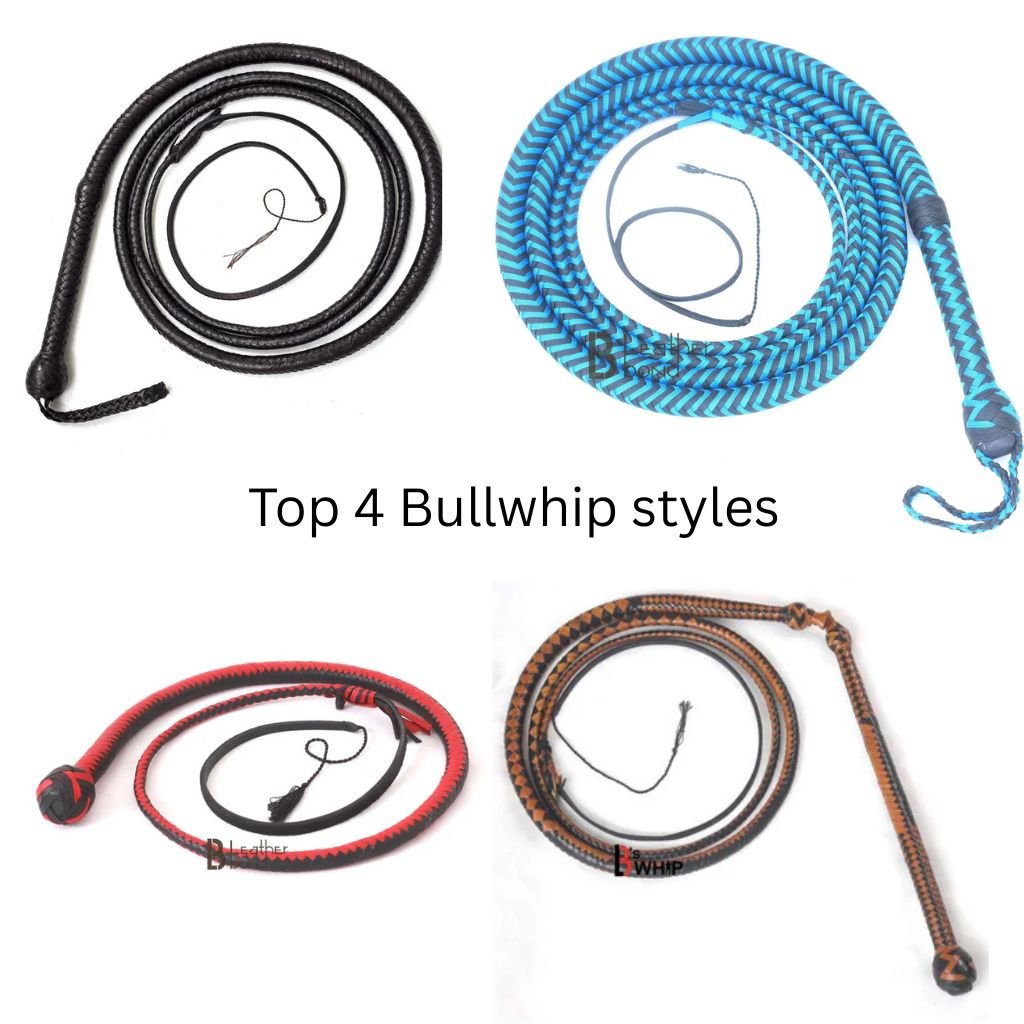
The term “whip” covers a broad family of objects. Understanding the distinctions matters when buying.
Bullwhip: A single-tail whip with an integrated handle the thong begins at the handle’s end and tapers toward the tip. Typically 1.5 to 3 metres in total length. The American style. Designed for accuracy and significant crack volume.
Stockwhip: An Australian-style whip where the handle and thong are separate pieces connected by a keeper. The handle is typically longer and more rigid than a bullwhip handle. Favoured by Australian drovers and still the dominant style in competitive whip cracking in Australia.
Signal whip: Shorter, lighter, and without a fall the cracker attaches directly to the end of the thong. Faster and more precise than a full bullwhip. Popular with performance crackers.
Snake whip: Similar to a bullwhip but with no rigid handle the handle section is also plaited leather, giving the whole whip flexibility. More portable. Slightly less accuracy at long range.
Quirt: A short, rigid-handled whip with two flat leather falls. A working tool rather than a cracking whip. Used close to the body for direct contact rather than cracking at a distance.
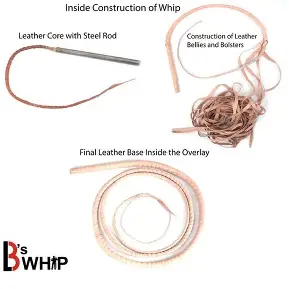
A bullwhip is not a single piece of leather. It is a layered, precisely constructed object with distinct components, each contributing to the whole.
The handle is the rigid section held during use. In a bullwhip, it is typically 20–30 cm long and built around a core of wood, fibreglass rod or tightly wrapped leather. The handle must be firm enough to transfer energy into the thong efficiently but not so heavy that it throws off the whip’s overall balance.
Quality handles are wrapped in plaited leather usually the same leather as the thong, giving the whip a visually continuous appearance. The wrapping must be tight and even; loose or uneven handle wrapping is a reliable indicator of poor construction overall.
The thong is the main body of the whip the long, tapering section that extends from the handle to the fall. It is where most of the whip maker’s skill is invested. The thong is built in layers: a twisted or braided core, one or more bolster layers, and a plaited outer overlay.
The taper of the thong how gradually and evenly it reduces in diameter from handle to fall is critical. An unevenly tapered thong produces inconsistent energy transfer and makes the whip unpredictable. Achieving a mathematically precise taper by hand, strand by strand, is one of the most technically demanding aspects of whip making.
The cracker also called the popper is a short length of nylon cord or braided fibre at the very tip of the whip. It is the component that breaks the sound barrier and produces the crack. Crackers wear out with regular use and are designed to be replaceable they are the consumable part of the whip.
A good handmade bullwhip will have a properly tied cracker that can be replaced by the user. Crackers tied with a simple overhand knot are easier to replace than those integrated more permanently.
The transition is the connection point between the rigid handle and the flexible thong. It must be both structurally strong it takes enormous stress every time the whip cracks and flexible enough not to create a dead point that interrupts energy flow.
Poor transitions are a common failure point in low-quality whips. The transition should be barely perceptible in a well-made piece the energy should flow through it seamlessly.
The fall is a length of single-strand leather typically 30–50 cm attached to the end of the thong before the cracker. It serves as a replaceable section between the permanent thong and the consumable cracker. Falls take significant wear and are also designed to be replaced.
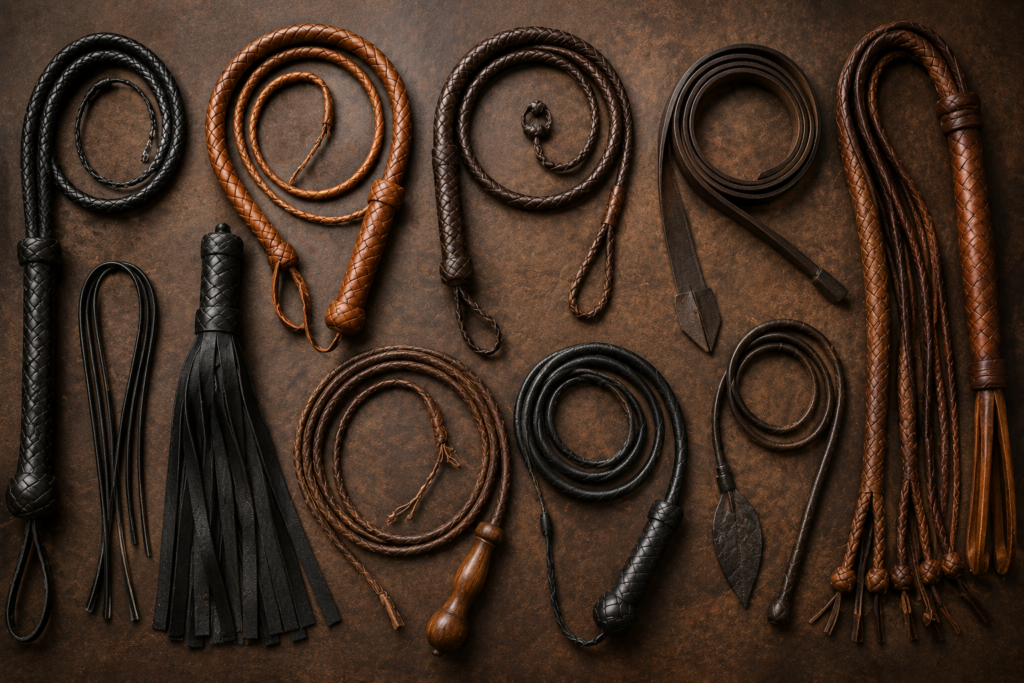
Everything begins with hide selection. A quality bullwhip maker is highly selective about raw material. The hide must be consistent in thickness, free from scarring or weakness, and correctly tanned for the application.
Vegetable-tanned leather cured using natural tannins from bark and plant materials is preferred for whip making. It is stiffer when dry, which helps the whip hold its shape, but softens as it works in and becomes more responsive over time. Chrome-tanned leather is too soft and stretchy for high-performance whip construction.
Strands are cut from the hide in one of two ways: hand-cut with a sharp knife guided by a ruler or cut using a purpose-made strand cutter. Hand-cutting is slower but allows the maker to follow the grain of the leather precisely cutting along the strongest direction of the hide.
Each strand must taper wider at the base, narrowing toward the tip to achieve the mathematical taper of the finished thong. Cutting consistent, accurate tapering strands by hand is a skill that takes years to master.
Before plaiting begins the core is built. The core determines the feel and responsiveness of the finished whip. A shot-loaded core where a length of lead shot is sewn into the centre adds weight to the handle end improving the crack and the swing. Leather bolsters are wrapped around the core to begin building the taper.
The number of core layers varies between makers and styles. More layers generally means a more refined taper and a more expensive whip.
The outer overlay is where the plaiting happens. This is the visible worked surface of the whip. Plait counts range from 8-plait simple and fast to make all the way to 32-plait and beyond for premium pieces.
Higher plait counts produce a smoother, denser surface. They take significantly longer to complete and require greater precision. A 16-plait overlay on a full-length bullwhip may involve cutting and weaving several hundred individual strand-lengths. A 32-plait piece at the same length represents an extraordinary investment of skilled time.
The plaiting must be kept under consistent tension throughout. Uneven tension produces visible inconsistencies in the pattern and more importantly, inconsistencies in the way the finished whip performs.
Once plaiting is complete the whip is dressed typically with neatsfoot oil or a leather conditioner to soften and protect the leather. Some makers apply multiple dressing treatments over days allowing each to absorb fully before the next application.
The finished whip is worked by hand flexed, shaped and broken in before delivery. A well-finished bullwhip should be supple and responsive from the first use not stiff and unyielding like an undressed piece.
| Leather Type | Properties | Performance | Common Use |
|---|---|---|---|
| Kangaroo hide | Highest tensile strength per mm, very fine grain | Lightest, most responsive, finest plait possible | Premium and competition whips |
| Cowhide (veg-tan) | Durable, widely available, consistent | Excellent performance, heavier than roo hide | Most traditional bullwhips |
| Buffalo hide | Very tough, coarser grain | Heavy, durable, less refined feel | Working and heavy-use whips |
| Nylon (non-leather) | Waterproof, very consistent | Good performance, lacks leather character | Practice and outdoor use |
The difference is not subtle. It is visible, tactile and audible.
Machine-made whips are typically produced from low-grade leather or synthetic materials, with machine-braided overlays that have no mathematical taper just a uniform braid applied over a tapered core. The result is a whip that performs inconsistently, doesn’t crack cleanly at lower effort, wears out quickly and often stiffens rather than improves with use.
Handmade whips are built strand by strand with tapering cuts, consistent hand tension, and a maker’s attention at every stage. The taper is precise. The balance is intentional. The performance is consistent. And the whip improves with use as the leather works in and the layers settle.
There is also a purely material difference. Machine-made whips typically use chrome-tanned leather cheap, soft and unsuitable for high-performance whip construction. Handmade whips from reputable makers use vegetable-tanned cowhide or kangaroo hide materials that perform correctly and age well.
Plait count: A higher plait count indicates greater skill and time investment. 8-plait is entry level. 12–16 plait is mid-range quality. 24-plait and above is premium. Ask the seller directly.
Taper consistency: Run your hand along the thong. The taper should feel smooth and gradual no sudden thickening or thinning. Inconsistent taper means inconsistent performance.
Handle construction: The handle should feel firm and balanced. Grip it and swing gently the weight should feel centred and natural, not tip-heavy.
Plait tightness and evenness: Look closely at the overlay. Each strand should be under even tension with consistent spacing. Loose plaiting or visible gaps indicate rushed construction.
Leather smell and texture: Quality vegetable-tanned leather has a clean, natural leather smell. It should feel dense and slightly waxy not soft and pliable like a fashion leather good. If it smells chemical or synthetic, the leather quality is questionable.
Maker provenance: Reputable makers stand behind their work with information about materials, construction methods, and care. Anonymous factory whips come with none of this.
| Length | Best For | Skill Level |
|---|---|---|
| 1.5–1.8 m | Indoor use, small spaces, beginners learning to crack | Beginner |
| 2.1–2.4 m | General use, learning full technique, most common size | Beginner–Intermediate |
| 2.7–3 m | Outdoor use, performance, experienced crackers | Intermediate–Advanced |
| 3.7 m + | Competition, display, expert use only | Advanced |
For a first bullwhip, a 1.8–2.1 m piece strikes the best balance between manageability and performance. Longer whips require more space, more technique, and more physical effort to crack consistently.
A quality handmade bullwhip, properly maintained, lasts decades.
After every use:
Every few months:
Storage:
Crackers:
A bullwhip has an integrated handle the thong begins directly at the end of the handle with no separate connection. A stockwhip has a separate rigid handle connected to the thong via a keeper loop. Stockwhips are associated with Australian droving tradition and tend to have longer more rigid handles. Both are single-tail whips and operate on the same physics but they have different feels and are used with slightly different techniques.
Kangaroo leather has a higher tensile strength per millimetre than cowhide meaning thinner strands can carry the same load. This allows whip makers to cut finer strands, plait more of them into a given overlay and produce a lighter more supple and more responsive whip than cowhide allows at the same length and plait count. It is also very fine-grained, producing a beautifully smooth finished surface. The trade-off is cost kangaroo hide is significantly more expensive than cowhide.
A basic 8-plait cowhide bullwhip from an experienced maker takes 8–12 hours of work. A mid-range 16-plait piece takes 20–30 hours. Premium 24-plait or 32-plait whips in kangaroo hide can take 40–60 hours or more of skilled work not including hide preparation and finishing time. This is why quality handmade bullwhips cost significantly more than machine-made alternatives.
Ask the maker directly about their construction process, materials and plait count. Genuine makers will answer in detail they know exactly how each whip was built because they built it themselves. Be sceptical of any seller who cannot tell you the plait count, the leather type or the core construction. Look closely at the plait itself handmade plaiting has subtle natural variation in tension that machine braiding lacks.
Shorter bullwhips 1.5 to 1.8 metres can be used with some techniques indoors in rooms with sufficient ceiling height and clear space. Cracking a whip requires the tip to travel through an arc and the tail needs clearance. In most standard-height rooms a well-controlled crack with a shorter whip is possible. Full-length whips of 2.4 metres or more are outdoor tools.
All bullwhips in our range are specified by plait count, leather type, length and construction style. Look for vegetable-tanned leather, a plait count of 12 or above for mid-range quality, and a detailed description of handle and core construction. Our handmade leather bullwhip collection includes options from entry-level to premium pieces — each described with full material and construction details.
A handmade leather bullwhip is one of the most technically accomplished objects in the leather craft tradition. The hours of skilled work embedded in a quality piece the precision strand cutting, the mathematical taper, the consistent plaiting under tension represent a craft lineage stretching back centuries across three continents.
Whether you’re buying as a collector, a performance artist, a sport cracker or simply because you appreciate genuine artisan leatherwork, understanding what goes into a handmade bullwhip changes how you see the object in your hands.
At LeatherBond, we stock handmade bullwhips built to the standard this guide describes real leather, proper plait counts, correct construction, and the kind of quality that lasts. Explore our leather whip collection and find the piece that suits your purpose.