An Indiana Jones whip is a 10-foot leather bullwhip styled after the one Harrison Ford carried in the Indiana Jones films. It is one of the most recognizable props in movie history, and it turned a niche craft into a household name. Decades later, people still search for one, whether they want a display piece, a costume accessory, or a real bullwhip to learn on.
This guide breaks down what an Indiana Jones whip actually is, where the design came from, and what to look for before you buy one.
An Indiana Jones whip is a leather bullwhip modeled on the prop used in the Indiana Jones movie series. It is not a separate category of whip. It is a bullwhip, built the same way any traditional bullwhip is built, that gets its name from the character who made it famous.
A bullwhip is a single-tail whip made from braided leather that tapers from a thick handle down to a thin end called the “fall,” which connects to a cracker or “popper.” The taper is what lets a bullwhip crack, since the tip moves faster than the speed of sound when the whip is used correctly.
What separates an “Indiana Jones whip” from a generic bullwhip is mostly styling and branding. Sellers use the name because the whip’s length, color, and handle shape echo the movie prop. The core construction underneath is standard bullwhip craftsmanship.
Movie props themselves are not always built the same way as whips meant for regular use. A prop only needs to look right on camera and survive a few takes. A functional bullwhip needs to hold up to repeated cracking, coiling, and handling over years. Keep that distinction in mind as you shop, since not every “Indiana Jones whip” for sale is built for real cracking.
Indiana Jones used a bullwhip, not a stock whip, snake whip, or riding crop. The bullwhip is his signature tool across the film series, used for swinging, disarming, and the occasional dramatic crack.
The Indiana Jones whip became part of the character almost by accident. According to production accounts, stunt coordinator Glenn Randall wove the whip into the story for the first film, and it stuck. From there, the Indiana Jones whip became as central to the character as the fedora or the leather jacket.
Because the character appears across multiple movies made over decades, the exact Indiana Jones whip used was not always identical. Different productions called for different lengths and different craftsmen, depending on the scene. A whip meant for a wide swinging shot has different needs than one used for a tight crack in close-up. That is normal for film props and does not take away from the whip’s iconic status.
Quick answer: Indiana Jones is most closely associated with a 10-foot bullwhip, though Indiana Jones whip lengths used across the films ranged more widely depending on the scene and the stunt.
The 10-foot length became the standard reference point because it was the size most identified with the character in publicity and merchandise. It offers a practical balance for on-screen work: long enough to look dramatic, short enough to control in tight spaces like temple sets and jungle paths.
Behind the scenes, whipmakers reportedly supplied a range of lengths for different stunts, from around 6 feet up to 16 feet, across the original trilogy. Shorter whips were easier to manage in confined shots, while longer ones were used for specific stunt work. Movie replicas and modern reproductions vary too, since manufacturers interpret the “Indiana Jones look” differently.
If you are shopping today, expect most Indiana Jones-style whips to fall between 6 and 12 feet, with the 10-foot version being the most common and the most recognizable.
The 10-foot bullwhip stuck as the character’s signature length for a few practical reasons.
Not every whip used in filming was exactly 10 feet, since production needs shifted scene by scene. But as a reference length for buyers today, 10 feet is the number most tied to the character.
David Morgan is a whipmaker whose name comes up constantly in discussions of the Indiana Jones bullwhip. His workshop is commonly credited with producing many of the whips used behind the scenes for the original trilogy.
Here is what is generally documented about that history:
It is worth being clear about one thing: not every Indiana Jones whip marketed today as an “Indiana Jones whip” is a David Morgan product. Many manufacturers, from budget costume brands to high-end leather crafters, make their own interpretation of the style. If a listing does not explicitly say David Morgan, assume it is a third-party replica rather than an original-maker whip.
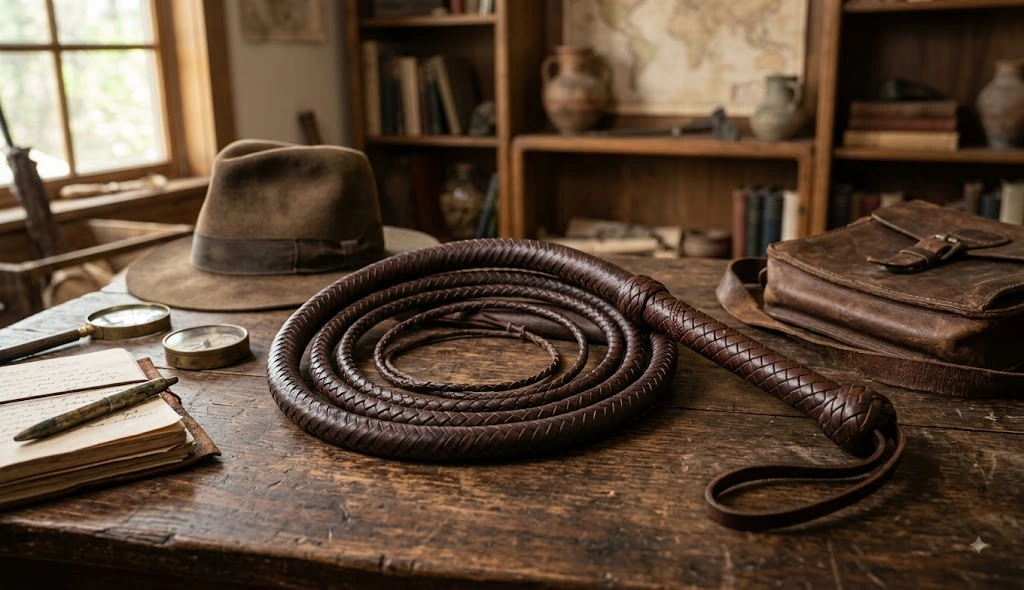
An Indiana Jones-style whip is not a different product from a standard bullwhip. It is a themed version of one. Here is how the two typically compare.
| Feature | Indiana Jones-Style Whip | Standard Bullwhip |
|---|---|---|
| Design | Styled to resemble the movie prop, usually natural tan leather | Varies widely by maker, region, and purpose |
| Typical appearance | Classic tan or brown leather, plain handle, minimal hardware | Ranges from plain working whips to decorative show pieces |
| Length | Most often 8 to 10 feet | Anywhere from 4 to 16 feet depending on use |
| Handle | Short, simple handle without ornamentation | Handle style depends on discipline (performance, stock work, target work) |
| Materials | Leather, sometimes kangaroo hide on premium versions | Leather, nylon, or paracord depending on price point |
| Main appeal | Movie nostalgia, collecting, costume use | Practical whip cracking, sport, performance, or livestock work |
| Typical use | Display, costume, casual practice | Competitive cracking, ranch work, stage performance |
The biggest practical difference is not construction, since both are built the same basic way. It is intent. A buyer looking for an “Indiana Jones whip” usually wants the look and the reference first, with function as a secondary concern. A buyer looking for a standard bullwhip usually starts with function.
Whether you want a display piece or something you plan to actually crack, a few construction details matter more than the branding.
Most buyers do well with an 8-foot or 10-foot whip. Shorter whips are easier to control while learning and take up less space to practice with. Longer whips look more dramatic but require more room and more skill to handle safely.
Kangaroo hide is the leather most prized in quality bullwhips because it is strong relative to its thickness, which allows for a thinner, faster Indiana Jones whip. Cowhide is heavier and more affordable, and it is common in mid-range and budget Indiana Jones whips. Bonded or “genuine leather” products at the low end of the market tend to be less durable and less consistent.
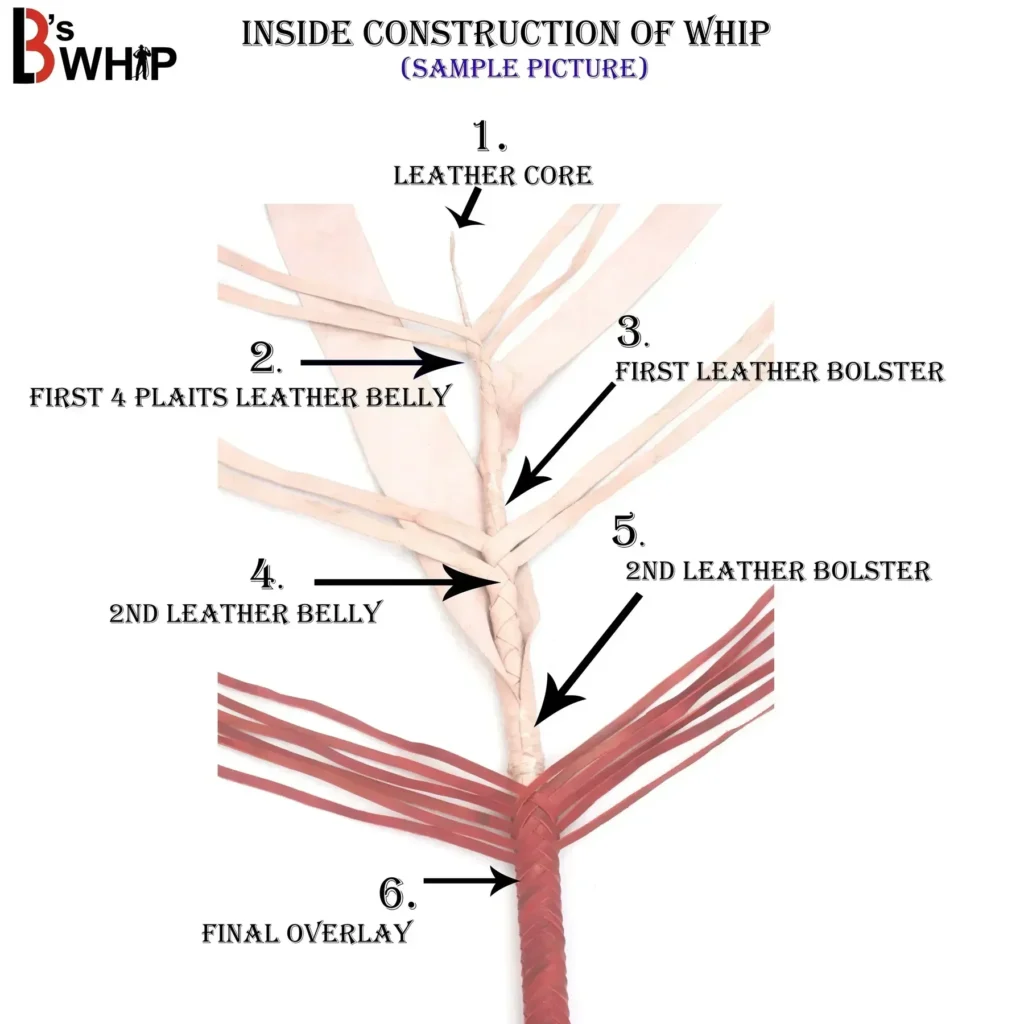
Plait count refers to how many strands of leather are braided together to form the whip’s body. Higher plait counts, such as 12-plait or 16-plait, generally produce a smoother, more refined whip. Lower plait counts, like 4-plait or 8-plait, are common on beginner or budget whips and are usually more affordable.
Underneath the braided leather sits a core that gives the whip its shape and taper. Common cores include rolled leather, nylon or a combination of materials. A well-built core keeps its shape over time and helps the whip flow smoothly through a crack. A poorly packed core can cause lumps or an uneven taper.
Check whether the handle has a rigid core (often wood, resin, or a similar material) covered in braided leather, or whether it is simply the thicker end of the leather braid itself. A firmer handle generally gives more control, particularly for beginners.
A Indiana Jones whip that is too heavy for its length can feel clumsy and tiring to use. A whip that is too light may feel whippy and hard to control precisely. Flexibility should be even along the length of the whip, without stiff spots or areas that feel noticeably looser than the rest.
Look closely at the stitching, the finish of the fall (the thin end section), and the overall symmetry of the braid. Uneven plaiting, loose strands, or a sloppy handle wrap are signs of lower-quality construction, even if the whip is marketed under the Indiana Jones name.
A 10-foot bullwhip is a strong default choice if you want the closest match to the classic Indiana Jones look, but it is not the only sensible option.
There is no single length that is objectively best. The right choice depends on whether you plan to actually use the whip, how much practice space you have, and whether screen accuracy matters more to you than ease of handling.
Not every whip sold under the Indiana Jones name is meant to be cracked. It helps to know which category you are actually buying.
Costume and display replicas are built primarily to look the part. They may use lower-cost materials, simplified construction or a rigid core that is not designed for repeated flexing. These are fine for cosplay, photos, or shelf display, but they are not built for real Indiana Jones whip cracking and can wear out or break quickly if used that way.
Film-inspired replicas sit in the middle. These aim to visually match the movie prop while using more functional materials than a pure costume piece, though quality varies significantly between brands.
Functional leather bullwhips are built the same way traditional working or performance whips are built, using proper plaiting, a flexible core and durable leather. These can handle regular practice and cracking, and they tend to cost more because of the labor and material involved.
A Indiana Jones whip that looks accurate in photos is not automatically a whip built for practical handling. If you plan to actually practice cracking, look for sellers who specifically describe the whip’s construction (plait count, core type, leather type) rather than relying on the “Indiana Jones” branding alone.
The fedora and the bullwhip are the two most recognizable pieces of the Indiana Jones look, so retailers frequently bundle them together as a matched set.
This pairing is largely about visual identity rather than function. The hat and whip do not need each other to work, but together they instantly signal the character to anyone who sees them. That makes the combination popular for Halloween costumes, themed parties, movie premieres, and collector displays.
For collectors building a themed setup, buying the hat and whip together (or from sellers who specialize in both) can also make it easier to match the tone and finish of the leather across both pieces.
Yes, with the right expectations. An Indiana Jones-style bullwhip can work well for a beginner, but success depends more on the whip’s construction than its branding.
Beginners generally do better with:
Whip cracking has a real learning curve, and improper technique can lead to injury, either to the user or to anyone standing nearby. Beginners should start slowly, learn from reliable instructional resources, and always practice with enough clear space around them before attempting to build up speed or more advanced cracks.
Leather bullwhips last much longer with basic, consistent care.
If you are buying an Indiana Jones-style whip for a collection, a few practical steps help you avoid disappointment.
Start by deciding what the whip is actually for. A shelf display, a costume accessory, and a Indiana Jones whip you plan to practice cracking all call for different priorities. Once you know the purpose, length and weight become much easier to choose.
Next, look past the marketing name and read the actual construction details. Leather type, plait count, and core material tell you far more about quality than the words “Indiana Jones” in a product title.
If you want a piece with real leather craftsmanship rather than a mass-produced costume prop, look for makers who describe their materials and construction process clearly. LeatherBond.co offers handmade leather goods built with attention to detail, which is worth considering if you want a whip that holds up to more than just sitting on a shelf.
Finally, factor in your budget realistically. A well-made leather bullwhip is a labor-intensive product, and prices reflect that. A very low price on a “genuine leather” whip is often a sign of shortcuts in materials or construction.
Indiana Jones uses a bullwhip, a single-tail leather whip that tapers from a thick handle to a thin end. It is not a stock whip or a riding crop. The bullwhip’s design allows it to crack, which became a signature sound and visual moment throughout the film series.
Indiana Jones is most commonly associated with a 10-foot bullwhip. Different scenes and stunts reportedly used other lengths, ranging from around 6 feet to 16 feet, but 10 feet is the length most tied to the character in merchandise and public memory.
Yes. It is specifically a bullwhip, identifiable by its tapered braided leather body and thin fall at the end. This is different from other whip types like stock whips or signal whips, which have different handle-to-thong ratios and different intended uses.
Not exactly, but they overlap heavily. A 10-foot bullwhip is a standard whip category on its own. An “Indiana Jones whip” specifically refers to whips styled after the movie prop, which most often happen to be 10 feet long.
David Morgan bullwhips are handcrafted whips from a whipmaking business commonly credited with supplying many of the whips used behind the scenes in the original Indiana Jones trilogy. They are known for kangaroo hide construction and detailed plaiting.
Real, functional bullwhips styled after the movie prop do exist and can be purchased from various leather crafters. However, many products marketed under the “Indiana Jones” name are costume replicas built mainly for appearance rather than actual cracking.
There is no single best length for everyone. Beginners often prefer 6 to 8 feet for easier handling, while collectors seeking screen accuracy typically choose 10 feet, matching the length most associated with the character.
They can be, if the whip is well-built and an appropriate length. Beginners should start with a shorter, well-balanced whip and practice in open outdoor space, since whip cracking takes practice and carries real safety considerations.
A movie replica is built mainly to look accurate, sometimes using simplified materials or construction. A functional bullwhip uses proper plaiting, a flexible core, and durable leather so it can withstand repeated cracking and handling.
Yes. Indiana Jones-style bullwhips are widely available from costume retailers, whip specialists, and leather goods makers, ranging from inexpensive display pieces to premium handcrafted whips built for real use.
Premium versions often use kangaroo hide, prized for its strength relative to thickness. More affordable versions typically use cowhide, and budget costume pieces may use bonded or synthetic leather.
Basic instruction is strongly recommended before attempting to crack a bullwhip. Improper technique can result in injury to the user or people nearby, so beginners should learn fundamentals in a safe, open space before progressing further.
An Indiana Jones whip is, at its core, a leather bullwhip styled after the prop made famous by Harrison Ford’s character, most commonly associated with a 10-foot length and a heritage tied to whipmaker David Morgan. Movie replicas and functional bullwhips can look similar but are not always built the same way, so it pays to look past the name and check the actual construction. When choosing one, weigh length, leather quality, plaiting, and intended use (display, costume, or real practice) before deciding, so the whip you buy actually fits what you plan to do with it.