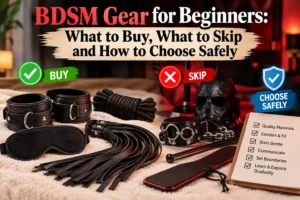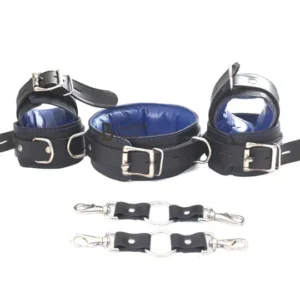
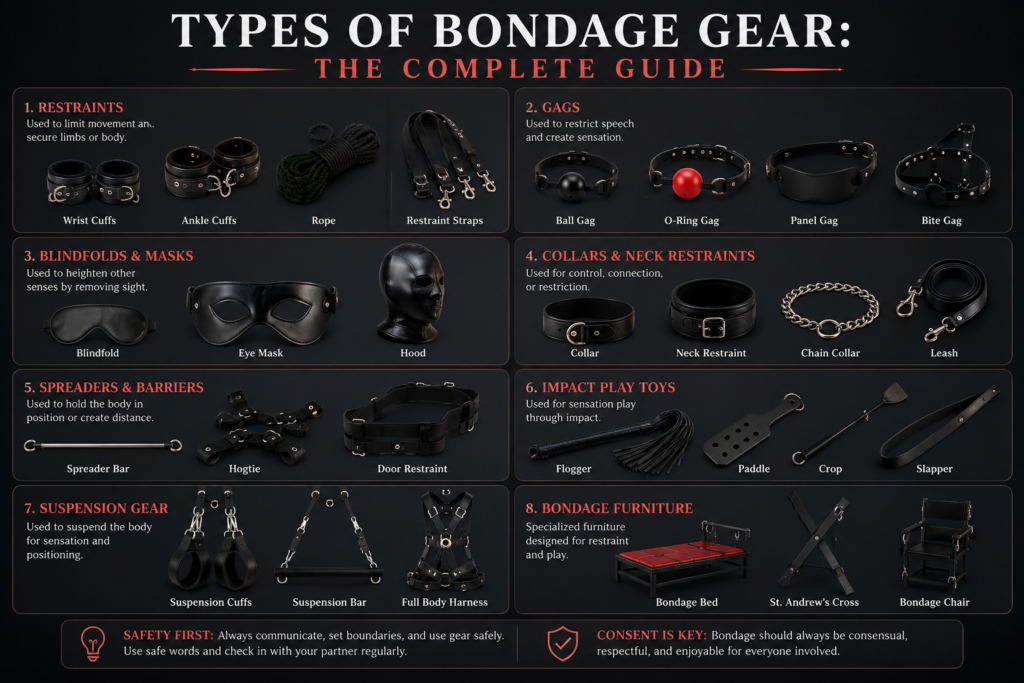
Bondage gear comes in many forms, from simple cuffs and soft restraints to rope, collars, harnesses, bondage kits and specialized equipment. With so many choices available, finding the right gear can feel confusing, especially if you are new to BDSM. The good news is that you do not need a large collection to get started. Understanding the different types of bondage gear makes it easier to compare materials, choose suitable equipment and build a setup that matches your experience level.
This guide explains the main types of bondage gear, what each category is designed for which materials are common and what to consider before buying. It also covers beginner-friendly options, care tips, and essential safety principles. Bondage instantly raises the hotness of the scene, which is part of why so many people find the idea of bondage to be so alluring. The “B” in BDSM stands for “Bondage,” which is the practice of physically restraining one’s partner (or self, in self-bondage). Bondage is an ideal entry point for engaging in BDSM play. It is suitable for both beginners and experienced kinksters. There are so many ways to incorporate bondage into your sex life or BDSM lifestyle. In this article, we’re going to explore how to practice bondage safely, and we’ll take you on a journey through the different types of bondage gear so you can find what’s best for you!
Quick answer: Bondage gear refers to equipment designed to restrict movement or support consensual restraint play. Common types include cuffs, bondage rope, bondage tape, collars, leashes, harnesses, bondage belts, restraint kits, spreader bars, and specialized restraint equipment.
Bondage is a versatile form of play suitable for people with all levels of experience. With all BDSM play, be it bondage or another form of kink, it’s important to respect consent and practice proper safety. You’ll need to negotiate with your partner (discuss the scene beforehand) and adhere to RISK (Risk, Aware, Consensual Kink) and SSC (Safe, Sane, Consensual) play to enjoy bondage safely and fully.
In BDSM, consent is when a participant gives permission to another person to perform BDSM or sexual activities with or on them. It can only be given if the person is in a rational state of mind (alcohol and drugs are best left out of BDSM play), and it should be unambiguous. A non-committal or lack of response should be considered a no. To have true consent, you must receive an unequivocal “Yes!” response to proposed activities.
Communicate with your partner and discuss the proposed scenario, including the potential risks. Always negotiate and set safe words and/or signals before any “scene” (a lifestyle term for a BDSM play session). We will discuss negotiation in more detail shortly.
If you’re new to bondage, keep things simple, start slowly, and restrain one part of the body at a time. This will give you time to get to grips with what you’re doing before you incorporate other things. Plus, taking it slowly heightens the anticipation. Enjoy each moment of the scene, and remember that you are taking your partner on a sensual and sexy journey.
You’ve negotiated, identified safe words/signals, and outlined limits – now it’s time to play! It’s natural to lose yourself in play, but you also need to keep an eye on proceedings is your partner enjoying the scenario as much as you are? Check-in with each other. There are ways to do this without breaking the excitement of the scene.
For example, during a spanking you could ask your partner, “Do you like that? Do you want more, you little slut?” or something similar that invites their feedback without ruining the sexy mood. With restraints, you want to ensure the person restrained isn’t too uncomfortable numbness and tingling can indicate restraints are overly tight.
Always be prepared. Even well-planned scenarios can run into problems on occasion. Make sure you can free your lover from their restraints quickly keep a pair of safety shears or medical scissors handy. It’s also wise to have a first aid kit available, just in case.
We’ve already touched on negotiation, which involves an in-depth conversation before any play takes place. This is a time for honesty and all players should be open about their likes and dislikes. You can even use a premade checklist for this (available in many BDSM books).
Boundaries, soft limits, and hard limits need to be discussed. What play is deemed acceptable and what should be avoided? A hard limit is something that the person absolutely is not okay with. A soft limit is something they are concerned about but might be open to exploring under the right conditions.
It’s also important to outline the scenario in terms of expectations and how each person would like things to proceed.
Safe words are needed to ensure the scene is safe, sane, and consensual. “Green,” “yellow,” and “red” are considered standard BDSM-safe words. Green indicates that everything is great, Yellow indicates play should be slowed down or decreased in intensity, and red is used to signify that play should immediately stop.
It’s a good idea to identify safe signals too. Occasionally safe words are lost in translation, especially if gags and hoods are being used. A tap of the hand on play equipment or dropping a held object could also be used to denote that play should cease.
Who will be in control of the scenario? One partner typically takes the role of the Top (the person acting upon the other) and the other partner takes the role of the Bottom (the recipient of the BDSM actions. There is much confusion regarding the terms Top/Bottom and Dominant/submissive. Top/Bottom refers to who is acting upon whom. Dominant/submissive refers to a form of power exchange in which one person willingly gives up some measure of control to the other, and this often forms the context for a BDSM relationship. It is often (but not always the case) that the Top will be the Dominant, and the Bottom the submissive.
If you’re interested in learning more about Dominant/submissive relationships, we offer a D/s dynamics class that offers foundational information, safety essentials, tips, and advice on how to form that dynamic healthily with your partner(s).
Determine exactly what gear will be used before play begins and work out how you will incorporate it into a scene. It’s always a good idea to take time to work out how to use the gear in your kit properly too. This way you avoid fumbling during the scene and ensure it goes smoothly.
Before you begin a scene, you need to talk about any concerns or potential triggers. For instance, a submissive might find hoods too challenging due to a past trauma or a bad experience. Will hoods be a hard limit or is it a boundary that can be explored during play (with due care and attention)? The Top needs to be aware of any issues so they can prepare and look out for any issues.
Play partners should also disclose any relevant medical conditions. Are there any disabilities or injuries likely to affect play? Are you taking medication or do you have a condition that needs to be treated immediately if symptoms arise (such as an inhaler for asthma or an epi-pen for an allergy)?
Despite our best-laid plans, play can sometimes go awry. What happens if a play partner becomes overwhelmed or unexpectedly becomes upset? How will you handle things if you or your partner become unwell during play? BDSM play often releases endorphins, and these can feel wonderful, but they can also contribute to a person feeling woozy or ill. It’s important to be prepared and monitor your partner. As the Top, it is your responsibility to end the scene if your partner becomes unwell. They may not be in a state of mind to utilize their safe word. It is always better to end a scene feeling that you could have gone further, rather than to take it too far and risk damaging your partner physically, emotionally, or psychologically.
Aftercare is a critical part of any scenario. When your scene ends, take the opportunity to look after one another. The Dominant should ensure the submissive is cared for — they may need a cuddle, a warm blanket, a drink, some food, or a chat. The Dominant has needs too. Both parties need time to decompress and adjust back into normal reality. Which activities your aftercare consists of may vary based on who you’re playing with, what you did, what happened during the scene, and other factors.
In this blog, we make gear recommendations based on your level of experience. We labeled these levels as Beginner, Intermediate, and Advanced. The recommended level of experience is based on multiple factors (explained below).
We recommend gear to players of specific levels to help you stay safe while playing. As with all forms of BDSM play, bondage play will never be 100% risk-free. Because there is always some level of risk, the best way to approach bondage is to follow the safety & consent guidelines we provided above and educate yourself on the type of gear you wish to play with.
It is important to note that practicing safety, consent, and clear communication are learned skills – it takes many play sessions and self-discipline to sharpen these essential skills!
Beginners are players who are new to bondage and/or BDSM. Beginners have little to no experience practicing safety & consent in BDSM. If you have limited experience having thorough negotiations, planning a scene ahead of time, using safewords, and communicating directly and clearly with a partner, we would qualify you as a beginner. Beginners are learning how to read their own bodies and those they play with (if applicable). It is important to learn how to listen to your body and know when to stop, slow down, or keep going!
We recommend beginners to start with entry-level bondage gear and resist the urge to play with more advanced gear! Establish a strong foundation first to best minimize risk in your future endeavors.
Intermediate players have explored BDSM before and feel comfortable following and practicing safety & consent guidelines. If you are new to bondage but have experience with BDSM play, you may border beginner and intermediate, but prior experience practicing safety and consent will help you easily advance!
Intermediate players know when to slow down, stop, or keep going based on what their and/or their partners bodies’ are telling them.
Advanced players have extensive experience with BDSM and bondage play. They are very comfortable with safety & consent rules and practice them consistently. They know how to safely explore new forms of play and gear. They are skilled at reading their own bodies as well as others and easily avoid pushing anyone past their limits. They know the basic information needed to play with a new type of gear (foundational rope knots, anal stretching, etc.) and are confident in their ability to learn new gear!
If you are comparing different options, this quick overview can help.
| Bondage Gear | Main Purpose | Beginner Friendly? |
|---|---|---|
| Bondage Cuffs | Wrist or ankle restraint | Yes |
| Bondage Tape | Flexible restraint | Yes |
| Bondage Rope | Versatile restraint | With proper education |
| Collars | Neckwear and role-play | Yes, with care |
| Leashes | Collar accessory | Yes, with care |
| Bondage Harnesses | Body restraint and styling | Yes–Intermediate |
| Bondage Belts | Waist restraint | Yes |
| Bondage Kits | Multiple restraint options | Yes |
| Spreader Bars | Position restraint | Intermediate |
| Bondage Hoods | Sensory restriction | Intermediate |
| Bondage Chains | Structured restraint | Intermediate |
| Restraint Furniture | Dedicated bondage setups | Advanced |
Not every product is suitable for every person. A beginner should generally choose simple, adjustable equipment that can be removed quickly.
Bondage cuffs are among the most recognizable types of bondage gear.
They are designed for wrists, ankles, or both. Many cuffs use adjustable closures, allowing the fit to be customized for different users. Common cuff materials include:
Leather cuffs are popular because they combine durability with a classic appearance.
Quality leather cuffs may also have padding or soft lining to improve comfort. They can be a good long-term option for someone who wants durable bondage equipment.
When shopping for leather cuffs, look for:
Nylon cuffs are lightweight and usually easy to adjust. They are often a practical choice for beginners.They are also commonly sold in sets containing wrist and ankle cuffs.
Metal restraints have a different feel and appearance from soft cuffs. However, their rigid construction means users need to pay closer attention to fit, pressure, and positioning.For beginners, softer and adjustable restraints are usually easier to manage.
Bondage rope is another major category of bondage gear.Unlike ready-made cuffs, rope requires knowledge of appropriate tying techniques and safety considerations. Different rope materials have different levels of softness, stretch, grip, and maintenance requirements.
Common options include:
Cotton is generally soft and approachable. It can be a practical choice for people learning about rope bondage.
Hemp is known for its natural texture and strong grip. Experienced rope users often appreciate how it handles knots.
Jute has a distinct texture and is commonly associated with traditional rope bondage.
Synthetic materials can offer consistency and easier maintenance. The exact characteristics depend on the material and manufacturer.
Rope bondage requires more knowledge than simply using adjustable cuffs.Before using rope, learn about:
Keep suitable safety scissors or shears accessible when working with rope.
Never assume that a beautiful rope pattern is automatically a safe one. Technique and body awareness matter more than appearance.
Bondage tape is a popular alternative to traditional rope.Unlike ordinary adhesive tape, purpose-made bondage tape is generally designed to adhere to itself rather than permanently stick to skin.This makes it convenient for temporary restraint and sensory applications.
It can be:
However, bondage tape still requires responsible use.Do not wrap restraints so tightly that they cause numbness, tingling, discoloration, pain, or other concerning symptoms.Always follow the manufacturer’s instructions.
A bondage collar is worn around the neck and can serve several purposes.
It may be used as:
Collars come in many designs, including leather, faux leather, fabric, metal, and synthetic materials.
Look for:
The neck is particularly vulnerable, so collars should not be treated like ordinary wrist or ankle restraints.Avoid using a collar to apply pressure to the neck. A collar should never be used to restrict breathing.If a collar is paired with a leash, keep the focus on controlled, gentle handling rather than forceful pulling.
Bondage leashes are accessories designed to connect with compatible collars or other attachment points.They are often made from combinations of:
A leash can complete the visual appearance of a collar and support consensual role-play.
Look at:
Remember that a leash does not make a collar suitable for pulling. The neck remains a sensitive area, and excessive force can cause serious injury.
Bondage harnesses are worn around parts of the body and can combine restraint, fashion, and role-play.
Popular designs include:
Leather harnesses are particularly popular because they offer a distinctive appearance and can be built for long-term use.A harness should fit securely without creating uncomfortable pressure.When choosing one, consider:
A good fit is more important than choosing the most elaborate design.
Bondage belts are designed around the waist or hips.
Depending on the design, they may include:
A bondage belt can be useful as part of a larger restraint system or as an accessory within a BDSM outfit. For beginners, look for adjustable designs that are easy to put on and remove.
A bondage kit combines several pieces of equipment into one package. A beginner kit may include items such as:
The exact contents vary between manufacturers.
A kit can make shopping easier because you do not have to research every individual item separately.It can also provide a convenient introduction to different types of bondage equipment.However, check the contents carefully before buying.A larger kit is not necessarily a better kit. Quality, fit, material, and safety features matter more than the number of pieces.
Spreader bars are specialized restraint equipment designed to maintain distance between attached points.
They commonly use cuffs or other compatible restraints at each end.
Because they can create stronger positional restrictions than simple cuffs, spreader bars are generally better suited to people who already understand basic restraint safety.
When choosing one, consider:
Beginners should first become comfortable with simpler restraint equipment before moving toward more restrictive setups.
Bondage hoods cover some or all of the head and may reduce visual or sensory input. Materials can include:
Hoods vary significantly in design.Some leave the eyes, nose, and mouth open. Others provide more extensive coverage.
Hoods require careful attention because they can affect communication, visibility, comfort, and breathing.Never assume that someone wearing a hood can communicate normally. Before using one, establish clear communication methods and make sure the wearer can breathe comfortably. Do not use a hood that creates breathing problems or blocks emergency communication.
Bondage chains are generally more rigid than rope and may be used with compatible cuffs, collars, or attachment hardware.They are available in different metals, finishes, lengths, and link sizes. Because chains can be rigid and heavy, users should pay attention to:
Chains are usually less forgiving than soft restraints, so beginners may prefer padded cuffs or flexible equipment first.
Arm binders and similar specialized restraints are designed to restrict movement more substantially than basic cuffs.
They can vary widely in construction and complexity.
These products are better suited to users who already understand restraint safety and communication.
Before purchasing specialized equipment, learn how it works and make sure you understand how to release it quickly.
Under-bed restraint systems are designed to provide attachment points beneath a mattress.They can be convenient because they do not require permanent furniture installation.Common systems use adjustable straps connected to cuffs.Before purchasing one, check:
Always verify that the system is installed and used according to its instructions.
Bondage furniture represents a more specialized category.
Examples can include:
This type of equipment is generally intended for dedicated BDSM spaces or experienced users.Because furniture can support substantial body weight and restrictive positioning, construction quality is extremely important.Look for reliable materials, secure attachment points, stable construction, and clear manufacturer specifications.
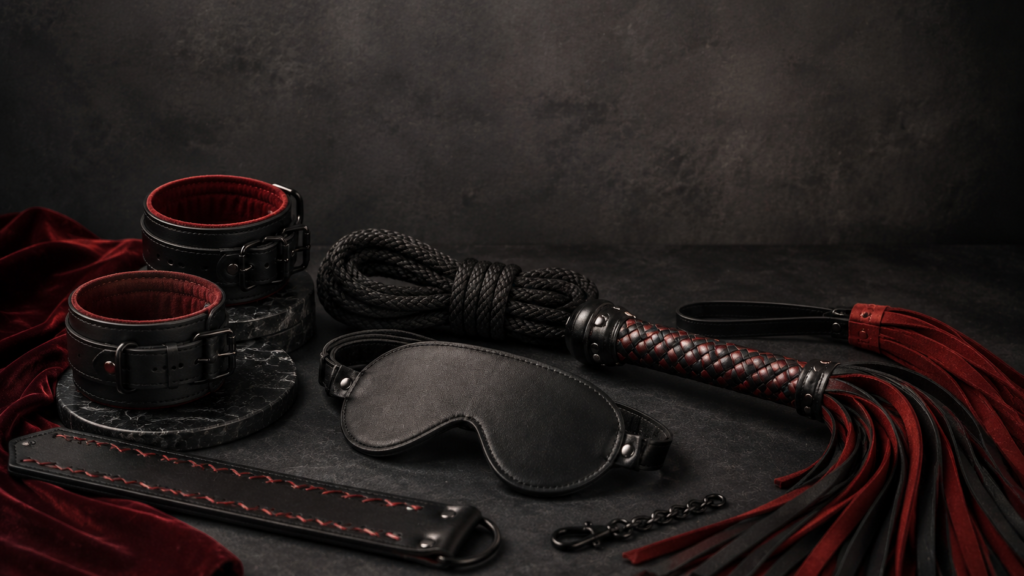
The best bondage gear is not necessarily the most expensive or advanced product.It is the equipment that fits your experience, preferences, body, and intended use.
Here are the most important factors to consider.
If you are new to bondage, start with simple equipment.
Good starting categories can include:
These options allow you to understand basic restraint concepts without immediately moving into complex equipment.
Once you are comfortable with basic restraint safety, you may explore:
Education becomes increasingly important as equipment becomes more restrictive.
Experienced users may explore specialized equipment and more complex setups.However, experience does not eliminate risk.Every new piece of equipment should be treated as something to learn before using.
Material can make a major difference in comfort, durability, appearance, and maintenance.
| Feature | Leather | Nylon |
|---|---|---|
| Appearance | Premium and traditional | Practical and modern |
| Durability | High with proper care | High |
| Comfort | Often very comfortable | Lightweight |
| Adjustability | Depends on design | Usually easy |
| Maintenance | Requires leather care | Usually easier |
| Price | Often higher | Often more affordable |
| Best For | Long-term gear | Beginners and practical setups |
Leather bondage gear is popular because it combines durability, appearance, and a distinctive feel.
Quality leather can last for years when properly maintained.
Nylon is lightweight, practical, and often affordable.
It can be an excellent choice for beginners who want straightforward equipment.
There is no universal winner. The best material depends on your preferences and priorities.
If you are completely new to bondage, you do not need a complicated collection.
A simple beginner setup might include:
Start with equipment that is easy to understand and quick to remove. Learn how each product works before combining multiple pieces.The goal should be familiarity and confidence rather than complexity.
Before buying bondage equipment, use this checklist.
Check what the product is made from.Leather, nylon, rope, metal, and synthetic materials all have different characteristics.
For leather and fabric products, inspect the stitching and reinforcement points.
Look at buckles, D-rings, O-rings, snaps, clips, and other hardware.They should be appropriate for the product’s intended use.
Adjustable equipment is often easier to fit correctly.This is particularly important when buying cuffs and collars.
Look for:
A restraint should never become impossible to remove. Understand the release mechanism before using it.
Safety should be part of the buying decision, not something you think about afterward.Bondage involves intentionally limiting movement, so communication and preparation are essential.
All bondage activities should involve informed consent between adults.
Talk about:
Do this before using the equipment.
A commonly used system is:
A nonverbal signal can also be useful when speech may be difficult.
Make sure everyone understands the signal before beginning.
Always know how to release the equipment.
Tight restraints can cause problems if they interfere with circulation or put pressure on nerves.
Pay attention to:
If something feels wrong, stop and remove the restraint.
The neck is not an area where restraint pressure should be applied.
Clear communication is essential. Alcohol or recreational drugs can interfere with judgment and communication, making responsible consent and safety more difficult.
Different materials require different cleaning methods.
Nylon is generally easier to clean.Follow the manufacturer’s washing instructions and allow it to dry completely before storage.
Rope care depends on the fiber.
Follow manufacturer instructions and inspect rope regularly for damage, contamination, or excessive wear.
Wipe metal components clean and dry them thoroughly.
Check for corrosion, sharp edges, or damaged hardware.
Proper storage can extend the life of your equipment.
Keep gear:
Store leather separately from materials that may damage its finish.
Avoid throwing all your gear into one container where buckles, chains, and hardware can scratch other items.
These terms are often used interchangeably, but there is a useful distinction.
Bondage gear specifically focuses on restraint and restriction.
Examples include:
BDSM gear is a broader category.
It can include bondage equipment along with:
So, bondage gear can be considered one part of the wider BDSM gear category.
The terms “gear,” “equipment,” and “toys” are not strictly standardized across the industry.
Generally:
Bondage gear refers to equipment designed around restraint or supporting a BDSM setup.
Bondage toys can refer to smaller items used during intimate or sensory play.
There can be considerable overlap between the two terms.
For shoppers, the most important thing is to understand the individual product rather than relying only on its category name.
Bondage gear is available across a wide price range.
The price can depend on:
A basic pair of cuffs may cost much less than a premium handmade leather restraint set.
Instead of choosing based solely on price, consider the total value.
A well-made product that lasts for years may offer better value than repeatedly replacing inexpensive equipment.
New buyers often make a few predictable mistakes.
A beautiful product is not useful if it does not fit comfortably.
Complex equipment often requires more knowledge.Build experience gradually.
Always understand how equipment comes off before putting it on.
If you are still unsure where to begin, use this framework.
Are you looking for:
Decide between leather, nylon, rope, fabric, metal, or synthetic materials.
Especially when purchasing your first restraints.
Look at stitching, closures, hardware, and attachment points.
Understand how the product should and should not be used.
Using multiple restraint products at once increases complexity.
Understand each product individually first.
The main categories include cuffs, bondage rope, bondage tape, collars, leashes, harnesses, belts, bondage kits, spreader bars, hoods, chains, and specialized restraint equipment.
Adjustable cuffs, bondage tape, simple collars, blindfolds, and beginner-friendly kits are common starting options. Choose equipment that is comfortable, easy to understand, and quick to release.
Yes. Leather is widely used for cuffs, collars, harnesses, belts, and other BDSM equipment. It offers durability and a distinctive appearance when properly maintained.
Nylon is lightweight, adjustable, and generally easy to handle, making it a practical choice for many beginners.
Rope requires proper education and technique. Incorrect tying can create pressure on nerves or affect circulation. Beginners should learn from reliable educational resources before attempting more complex rope bondage.
Consider size, adjustability, material, padding, stitching, hardware, and the release mechanism. Comfort and fit should be priorities.
A basic kit may include wrist cuffs, ankle cuffs, connecting straps, and a blindfold. The exact contents vary by manufacturer.
Yes. Many products are designed for beginners. Start with simple equipment and learn the safety principles before progressing to more specialized gear.
Clean it according to the manufacturer’s instructions, allow it to dry properly, and store it in a cool, dry place away from direct sunlight and excessive moisture.
Not exactly. Bondage gear focuses primarily on restraint, while BDSM gear is a broader category that can include restraint equipment, sensory accessories, impact equipment, furniture, and other products.
The world of bondage gear is much broader than a simple pair of cuffs.
From leather restraints and adjustable nylon cuffs to rope, bondage tape, collars, harnesses, kits, and specialized equipment, there are options for different preferences and experience levels.The best approach is to start with the basics.Choose equipment that fits properly, understand its materials, learn how the release mechanism works, and communicate clearly with your partner. As your knowledge grows, you can decide whether more specialized equipment is right for you.Most importantly, good bondage equipment should support consent, communication, comfort and responsible use.
The goal is not to own the most gear. It is to choose the gear that fits your needs and use it thoughtfully.