Few objects in human history have served as many roles as the whip. It has been a working tool a weapon, a performance instrument, a sporting implement, a symbol of authority and a craft tradition spanning centuries across multiple continents.
Most people recognise a whip instantly but know very little about what it actually is, how it works or why the tip produces that distinctive crack. That crack one of the most recognisable sounds in the world is a small sonic boom. The tip of a well-made whip breaks the speed of sound, approximately 1,235 km/h at sea level.
This guide covers everything. What a whip is, how it works, every major type explained clearly, what each part does and what different whips are actually used for. Whether you’re curious, buying or simply interested in the craft, this is where to start.
A whip is a flexible instrument typically made from leather, braided cord, or similar material designed to be swung through an arc to produce either a crack, direct contact, or both. The defining characteristic of a whip is its taper: it is widest and heaviest at the handle end and becomes progressively thinner toward the tip. This taper is what allows energy to transfer from the user’s arm motion all the way to the tip, accelerating the tip to remarkable speed.
Whips are not a single object. They are a family of related tools bullwhips, stockwhips, signal whips, floggers, crops, quirts each with different construction, different physics and different intended uses. What they share is that taper principle and the basic mechanics of energy transfer through a flexible medium.
The use of whips as tools and instruments of authority dates back to the earliest human civilisations. Ancient Egyptian tomb paintings depict figures carrying whips. Mesopotamian texts reference their use in animal management and as symbols of power. Archaeological evidence suggests simple whips leather strips or braided cord attached to handles were in use across the ancient Middle East, Egypt and the Mediterranean world several thousand years before the modern era.
In these early contexts, whips served primarily practical purposes: directing animals, managing livestock and as agricultural tools. The refinement of construction layered cores, tapered plaiting, replaceable tips came considerably later.
The whip’s role as a working tool peaked during the era of large-scale animal-powered agriculture and transportation roughly the seventeenth through nineteenth centuries. Coachmen, drovers, farmers and cavalry all relied on whips as essential working instruments.
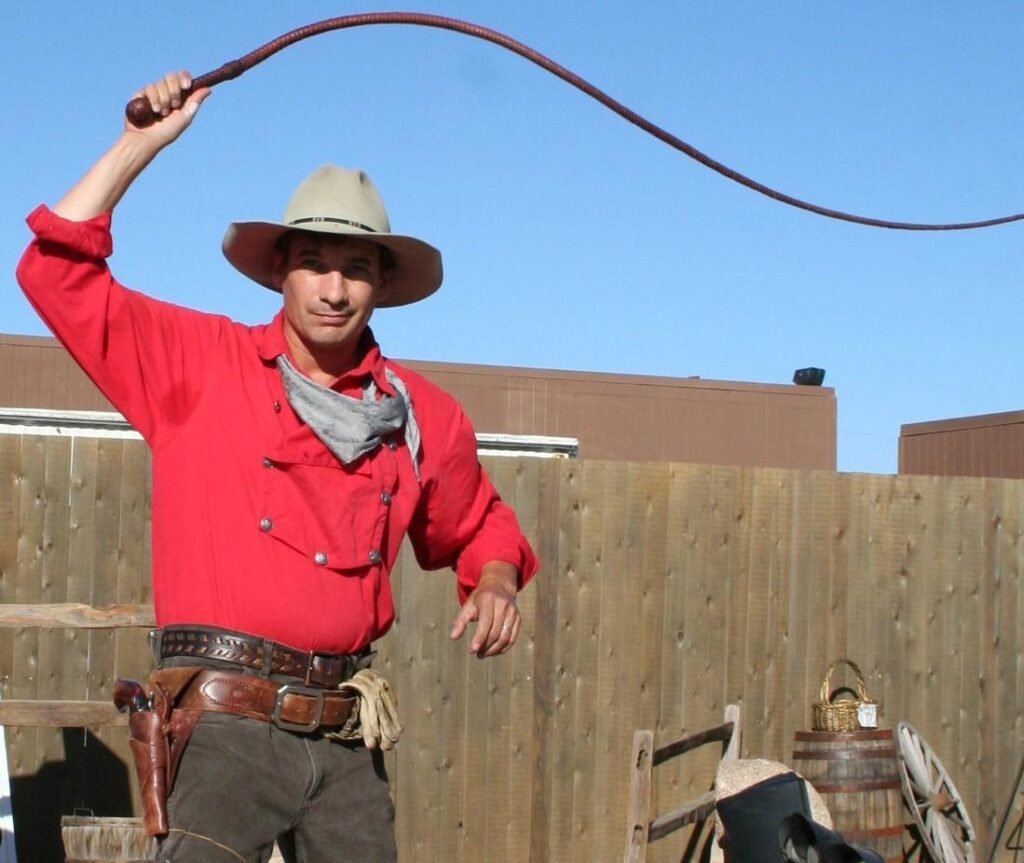
The American cattle era (roughly 1860–1900) produced the iconic bullwhip tradition. Drovers moving enormous herds across the Great Plains used long whips to direct animals through sound rather than physical contact a precise crack near a specific animal was enough to redirect it without harm.
In Australia, the parallel stockwhip tradition developed alongside the growth of sheep and cattle stations in the interior. Australian whip makers, working with kangaroo hide, produced some of the finest whip craft in the world pieces that are still the global benchmark for quality.
The working whip began its decline with the mechanisation of agriculture and transport through the twentieth century. But the craft tradition it generated continued and in some contexts, intensified.
As the working role of whips diminished, their performance and sporting roles grew. Circus performers developed whip cracking as a standalone art figures like Antonio Marro and later Señor Mendez became famous for their precision and speed work. Wild West shows brought the skill to mass urban audiences.
Whip cracking as a competitive sport developed formal structures through the twentieth century. The American Whip Crackers Association and the Australian Whipcracking Association both hold competitions with standardised disciplines speed cracking (how many cracks per minute), accuracy (hitting specific targets), and freestyle (artistic performance). World records in whip cracking are officially tracked and competed for internationally.
The bullwhip’s most enduring cultural moment came in 1981 with Indiana Jones and the Raiders of the Lost Ark. Harrison Ford’s 3-metre, 16-plait whip custom made by maker Leatherbond became one of the most iconic props in cinema history and introduced a generation to whip culture.
Beyond cinema, whips appear consistently across literature, television, equestrian sport, theatrical performance and BDSM culture. Each context uses a different type of whip for different purposes but the cultural recognition of the object spans all of them.
The mechanics of a whip are elegant. Energy travels as a wave from the handle toward the tip. As the thong tapers getting progressively thinner and lighter the wave has less and less mass to move. By the law of conservation of momentum, the velocity increases to compensate for the reducing mass.
By the time the wave reaches the cracker at the very tip, the mass is tiny and the velocity is enormous. The tip accelerates past the speed of sound approximately 1,235 km/h at sea level under standard conditions and produces a small sonic boom. That is the crack.
The mathematics were formally worked out by researchers at the University of Queensland in 2002, who published an analysis in the journal Science confirming that whip crackers do indeed break the sound barrier. The study also showed that the whip’s taper does not need to be perfectly smooth the crack can still be produced with some irregularity but a precise, consistent taper produces a cleaner, louder and more reliable crack.
A longer, heavier whip requires more energy from the user to crack but produces a louder sound. A shorter, lighter whip is easier to crack but at lower volume. A poorly tapered whip distributes energy inconsistently and produces an unreliable crack regardless of user skill.
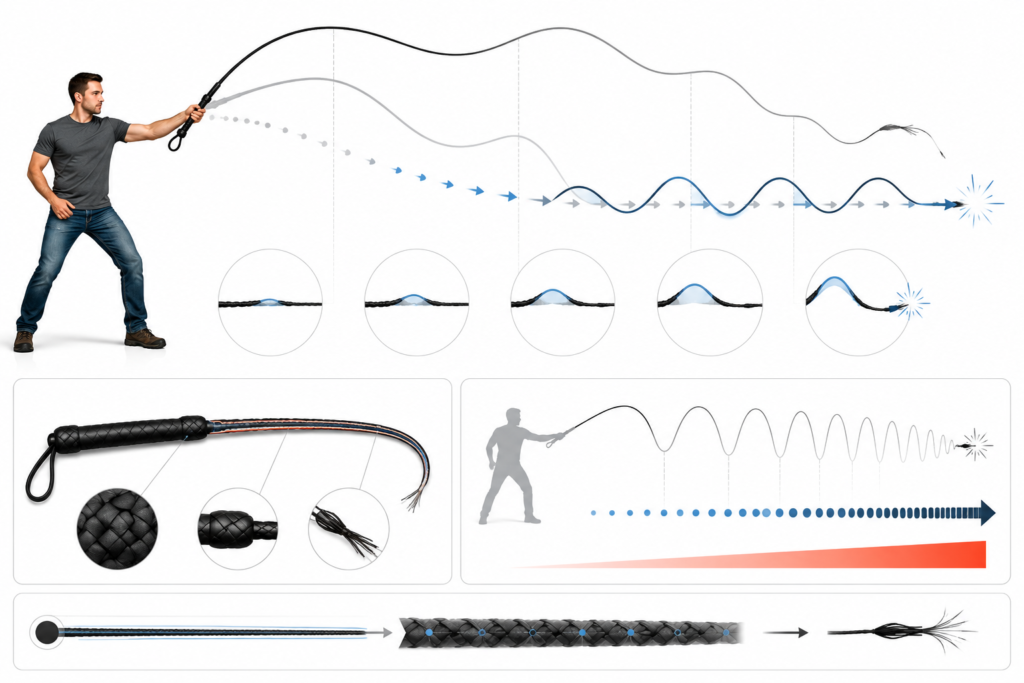
Understanding the anatomy of a whip is essential for assessing quality, understanding performance, and discussing whips with any precision.
The handle is the rigid section held during use. It typically runs 20–35 cm in length depending on whip type and style. Handles are built around a core traditionally wood but also fibreglass rod, rolled leather or a shot-weighted core wrapped in plaited leather.
The handle must be rigid enough to transfer the user’s arm motion efficiently into the thong without absorbing energy. A handle that flexes too much dissipates the initial impulse before it reaches the thong. Handle weight and balance affect the feel of the entire whip dramatically a well-balanced handle makes cracking feel effortless a poorly balanced one makes the whip feel wrong in the hand regardless of its other qualities.
The thong is the main body of the whip the long, tapered section extending from the handle to the fall. It is where the maker’s skill is most visibly invested. A high-quality thong is built in layers, an inner core of twisted leather or weighted material one or more bolster layers that begin building the taper and a plaited outer overlay.
The taper of the thong how precisely and consistently it reduces in diameter from handle to tip is the single most important factor in a whip’s performance. An uneven taper disrupts energy transfer and produces an inconsistent crack. Achieving a mathematically precise taper by hand, strand by strand, through hundreds or thousands of individual plaiting moves, is the defining skill of a master whip maker.
The fall is a single strip of leather typically 30–50 cm long attached to the end of the thong. It serves as a replaceable buffer between the permanent thong and the consumable cracker. Falls take significant wear from repeated cracking and are designed to be replaced before the thong itself is affected.
Falls are made from a single piece of quality leather vegetable-tanned cowhide or kangaroo hide in premium pieces cut to a consistent width and tapered slightly at the tip.
The cracker also called the popper is a short length of nylon cord or braided material at the very end of the whip. It is the part that actually breaks the sound barrier. Crackers are designed to be fully consumable they fray and wear out with use and require regular replacement.
A quality cracker is tied to the fall in a way that allows straightforward user replacement. Most quality whips come with spare crackers or make them readily available. A whip that won’t crack properly despite correct technique almost always needs a new cracker this is the first thing to check.
The transition is the connection point between the rigid handle and the flexible thong. This is a high-stress zone it must allow the energy transfer between handle and thong without creating a dead point, while being structurally robust enough to withstand the repeated stress of cracking.
A keeper is the connection loop used in stockwhips specifically a separate flexible element that connects the rigid handle to the independently attached thong. The presence or absence of a keeper is the defining structural difference between a bullwhip (no keeper, integrated) and a stockwhip (keeper present, separate).
The most iconic single-tail whip. Integrated handle the thong begins directly at the end of the handle with no separate connection. Designed for cracking at range. Typical lengths range from 1.5 to 4.5 metres. The American tradition with roots in cattle droving. The primary whip type used in performance, sport cracking, and BDSM practice.
The Australian tradition. Separate handle connected to the thong via a flexible keeper loop. Handles are typically longer and more rigid than bullwhip handles 45–60 cm is common. Designed for the specific demands of mounted cattle work on open Australian stations. The stockwhip produces a crack through a different swing mechanic than the bullwhip the long handle acts as a lever, and the keeper provides a pivot point.
Short typically under 1.5 metres in total length. No leather fall, the cracker attaches directly to the end of the thong. Faster and more manoeuvrable than a full bullwhip. Very popular in performance cracking for speed work and close-quarters technique. Named for its historical use as a signal tool a series of cracks used to communicate over distance.
Like a bullwhip but without a rigid handle. The entire whip is flexible from end to end the handle section is plaited leather like the thong with no internal rigid core. This makes the snake whip more packable and compact and gives it a distinctive fluid feel in use. Slightly less power transfer than a rigid-handled bullwhip of equivalent length but preferred by some crackers for the feel.
A short, rigid-handled tool with two flat leather tails called falls hanging from the end of the handle. The quirt is a contact tool not a cracking whip. It is used in direct contact with animals (historically) or in BDSM practice for light striking. Typical length is 40–60 cm including handle. It does not crack.
A thin, rigid shaft typically fibreglass or cane wrapped in leather with a small leather keeper loop or striking flap at the tip. Used in equestrian sport for precise cues and corrections. Also common in BDSM practice as an impact tool for light, targeted striking. Does not crack in the sonic boom sense the flap slaps with a sharp sound at very close range.
A multi-tail instrument multiple leather, suede, rubber or fabric tails attached to a single handle. Not a single-tail whip. The flogger does not crack and does not operate on the same physics as any single-tail whip. It is used exclusively in BDSM impact play, delivering sensation through direct contact of the tails with the body rather than through a cracking mechanism. The distinction between a flogger and a whip is fundamental they are completely different tools.
A specific type of multi-tail whip with nine tails historically braided cord or leather, sometimes knotted at the ends. Originally a punishment instrument with a documented history in naval and military discipline. Today, “cat o’ nine tails” in BDSM contexts usually refers to a leather multi-tail flogger-style instrument with nine strands. The historical version was designed to cause serious harm modern BDSM versions are built for sensation not injury.
A long, thin, highly flexible whip designed for use from a horse-drawn vehicle reaching the lead horses of a team without the driver needing to stand or move. Very long (often 2.5–3.5 metres), very light and not designed for cracking in the performance or sport sense. Largely a historical artefact still made by specialist craftspeople but with minimal practical application today.
| Type | Handle | Tails | Length | Cracks? | Primary Use |
|---|---|---|---|---|---|
| Bullwhip | Rigid, integrated | Single | 1.5–4.5 m | ✓ Yes | Performance, sport, BDSM |
| Stockwhip | Rigid, separate (keeper) | Single | 1.8–3.5 m | ✓ Yes | Cattle work, sport |
| Signal whip | Rigid, integrated | Single (no fall) | 0.9–1.5 m | ✓ Yes | Performance, speed work |
| Snake whip | Flexible throughout | Single | 1.2–2.4 m | ✓ Yes | Performance, compact use |
| Quirt | Short rigid | Two flat falls | 40–60 cm | ✗ No | Contact tool, BDSM |
| Riding crop | Thin rigid shaft | Small leather flap | 60–90 cm | ✗ No | Equestrian, BDSM |
| Flogger | Solid handle | Multiple (8–40+) | 40–80 cm | ✗ No | BDSM sensation/impact |
| Cat o’ nine tails | Solid handle | Nine strands | 50–80 cm | ✗ No | BDSM impact |
| Buggy whip | Long, very flexible | Single, no cracker | 2.5–3.5 m | Limited | Historical, driving |
Kangaroo leather: Highest tensile strength per millimetre of any common leather. Allows finer strand cutting, higher plait counts, lighter and more responsive whips. The premium standard for single-tail whips.
Vegetable-tanned cowhide: The traditional American bullwhip material. Durable, characterful, excellent performance. Stiffens when dry, becomes more supple with use and conditioning.
Nylon paracord: Consistent, waterproof, lower cost. Good performance for practice and outdoor use. Lacks the character, weight nuance, and craft of leather.
Braided polyester: Common in budget whips. Adequate for casual use. Does not hold up to sustained performance cracking or carry the aesthetic quality of leather.
Chrome-tanned leather: Too soft and stretchy for quality single-tail construction. Used in budget pieces where cost is the priority. Degrades under repeated dynamic load.
Livestock management (historical and ongoing): Directing cattle, horses and sheep through sound rather than contact. Still used on traditional stations in Australia and in some working equestrian contexts.
Performance art: Whip cracking as theatre speed, accuracy and artistic display. Circus performers, Wild West show acts, and stage performers.
Competitive sport: Formal disciplines including speed cracking (cracks per minute), accuracy (target hitting), and freestyle. International organisations track records and hold competitions.
Equestrian sport: Riding crops and driving whips are standard equestrian equipment cues and corrections rather than punishment in skilled hands.
BDSM practice: Floggers, crops, quirts and (at advanced levels with training) single-tail whips are used in consensual impact play. Each type serves a different purpose and carries a different skill and risk profile.
Collecting and craftsmanship appreciation: Quality handmade whips particularly high-plait kangaroo hide pieces are sought as artisan objects by collectors worldwide.
This distinction matters enormously, particularly for anyone buying for BDSM practice.
A whip (single-tail) operates on the physics of energy transfer through a tapered medium. The tip reaches supersonic speed. It can crack without making body contact at all. In skilled hands at close range it delivers precise, intense sensation but demands significant skill. In unskilled hands it is genuinely dangerous, capable of breaking skin.
A flogger (multi-tail) has no taper physics. It does not crack. Its multiple tails make body contact simultaneously across a broad area. Force is distributed not concentrated into a tip. A flogger is significantly more forgiving of imperfect technique. The sensation it produces ranges from gentle warmth to intense thud or sting depending on material and weight.
For BDSM beginners: a flogger is the appropriate starting point. A single-tail whip is an advanced tool requiring specific training.
For learning to crack: A 1.8–2.1 metre bullwhip in 12-plait vegetable-tanned cowhide is the best starting point. Manageable length, honest quality, forgiving enough for technique development.
For performance cracking: A 16-plait cowhide or kangaroo hide bullwhip in the 2.1–3 metre range. Higher plait count produces more consistent energy transfer and a cleaner crack.
For competitive sport: Kangaroo hide, 16-plait or above, in the length specified by your competition discipline. Consult your competition organisation for equipment rules.
For BDSM impact play (beginner): A suede or soft leather flogger. Not a whip. Build skill and communication with a flogger before any consideration of single-tail work.
For BDSM single-tail work (advanced only): A signal whip or short bullwhip, with in-person training from an experienced practitioner first. This is not a beginner category regardless of how comfortable you are with other BDSM gear.
For collecting: Kangaroo hide, 16-plait to 32-plait, from a named maker who builds by hand and can describe their construction in detail. These pieces age beautifully and represent genuine craft heritage.
At LeatherBond, our leather whip collection covers every purpose from first-time buyers learning to crack to collectors seeking premium handmade pieces. Every item is specified by material, plait count, and construction.
The crack is a sonic boom a small shockwave produced when the tip of the whip exceeds the speed of sound. As the wave of energy travels down the tapered thong the progressively smaller mass at the tip must move faster to conserve momentum. By the time it reaches the cracker, the velocity exceeds approximately 1,235 km/h and breaks the sound barrier. This was formally confirmed by University of Queensland researchers in 2002.
A whip is a single-tail instrument that operates on taper physics it can crack and concentrates all force into one tip. A flogger has multiple tails, does not crack and distributes force across a broad area. They are completely different tools requiring different technique and carrying different risk profiles. Floggers are appropriate for beginners; single-tail whips are not.
For whip cracking as a skill: a 1.8–2.1 metre, 12-plait vegetable-tanned cowhide bullwhip is the ideal first piece. For BDSM impact play, a suede flogger not a whip. For equestrian use: a quality leather riding crop appropriate to your discipline.
Most people can produce a basic crack within their first one to three sessions with a quality whip. Consistent, reliable cracking in a controlled manner knowing exactly where the crack will happen and being able to repeat it accurately takes weeks of regular practice. Advanced techniques like multiple-crack sequences, accuracy targets and speed cracking take months to years.
No. Both are single-tail cracking whips but they differ in construction. A bullwhip has an integrated handle the thong begins directly at the handle’s end. A stockwhip has a separate handle connected to the thong via a flexible keeper loop. The stockwhip is the Australian tradition; the bullwhip is the American tradition. Both crack, but through slightly different mechanics and with different feel in the hand.
LeatherBond stocks a full range of handmade leather whips bullwhips and floggers with full material and construction specifications. Browse our leather whip range for individually specified pieces or our flogger collection for BDSM-specific options.
A whip is one of the oldest, most technically interesting and most culturally layered objects in human history. Its physics are remarkable. Its craft tradition is centuries deep. Its range of forms from the working stockwhip of the Australian outback to the precision competition bullwhip to the BDSM flogger reflects the breadth of human uses for a single fundamental design principle: a flexible, tapered tool that transfers energy to a tip.
Understanding what a whip is, how it works, and which type serves which purpose is the foundation for everything that comes after whether you’re learning to crack, buying for collection or exploring BDSM practice responsibly.
At LeatherBond, every whip and flogger in our range is built from the right materials for its purpose, specified in full and made to last. Explore our complete whip and flogger collection and find the piece that suits your purpose.