A BDSM test is a self-assessment quiz designed to help people understand their preferences, tendencies, and comfort levels within kink and power-exchange dynamics. Rather than predicting a fixed identity, a good BDSM test acts as a mirror reflecting patterns in what you find appealing, what you’re curious about and where your boundaries sit today.
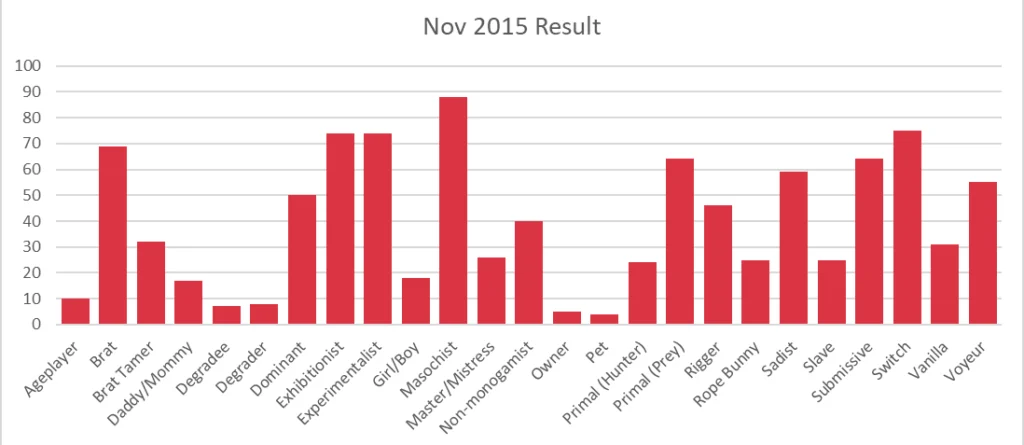
These tests have become a popular starting point for people new to kink as well as a useful check-in tool for experienced practitioners who want language to describe what they want. The results are typically presented as a breakdown across multiple “roles” or archetypes such as Dominant, Submissive, Switch, Rope Bunny, Sadist, Masochist and more each scored as a percentage based on your answers.
It’s worth saying clearly upfront: a BDSM test is not a clinical or scientific instrument. It doesn’t diagnose anything, and it isn’t a personality test in the psychological sense. It’s a self-reflection tool most useful when treated as a conversation starter rather than a verdict.
Most BDSM tests follow a similar structure:
The underlying categories used by most reputable BDSM tests are based on community-developed frameworks that have circulated in kink education spaces for years, refined through community feedback rather than formal psychological research.
While different tests use slightly different labels, most measure variations of the following roles:
Someone who enjoys taking control, setting rules, and guiding a scene or relationship dynamic. Dominance isn’t about cruelty it’s about responsibility, decision-making, and holding space for a partner’s trust.
Someone who finds fulfillment in releasing control, following direction, and trusting a partner to guide the experience. Submission is an active choice, not passivity it requires just as much self-awareness as dominance.
A person who enjoys both dominant and submissive roles, depending on the partner, mood, or scene. Switches often describe their preference as context-dependent rather than fixed.
Someone who finds enjoyment in giving sensation including intense sensation to a consenting partner, often deriving satisfaction from their partner’s reactions and trust.
Someone who finds enjoyment in receiving sensation, including intense physical sensation, within a consensual and controlled context.
These roles relate specifically to rope bondage the Rigger enjoys tying, while the Rope Bunny enjoys being tied. This is often treated as a separate skill-and-interest category from the broader dominant/submissive spectrum.
A Brat enjoys playful resistance and testing limits within a scene. A Brat Tamer enjoys the dynamic of responding to and “taming” that resistance a popular dynamic that blends dominance with humor and play.
A category included in most tests to represent low interest across kink-specific categories useful as a baseline comparison score.
There are several common reasons people seek out a BDSM test:
Self-discovery. Many people are curious about kink but unsure where to start. A test offers a low-pressure way to explore preferences without needing prior experience.
Communication with a partner. Couples often take a BDSM test together (or compare individual results) as a way to open conversations about desires that might otherwise feel awkward to bring up directly.
Vocabulary building. Kink communities use specific terminology, and a test can introduce that vocabulary in a structured, judgment-free way.
Confirming or challenging assumptions. Some people take a test expecting one result and are surprised by another prompting genuine self-reflection about desires they hadn’t consciously named.
Preferences shift with experience, partners, mood, and life stage. A result taken today might look different a year from now that’s normal and expected.
Many people score moderately high across several roles. This doesn’t mean the test is “wrong” it reflects the reality that desire is often fluid and context-dependent rather than fitting into one box.
Even with a clear result, communicating directly with a partner about boundaries, interests, and limits is essential. A test result is a starting point for that conversation not a substitute for it.
Scoring high in an unfamiliar category doesn’t obligate you to try it. It simply reflects an area worth exploring at your own pace, if and when you choose to.
Because BDSM tests ask personal questions, it’s worth being selective about where you take one:
A trustworthy BDSM test should feel like a private, judgment-free space for self-reflection.
A BDSM test reflects your current self-reported preferences based on the questions asked. It’s a useful reflection tool but it isn’t a clinical or definitive measurement think of it as a conversation starter not a diagnosis.
Yes. It’s common and normal for results to shift as you gain experience, try new things or simply grow as a person. Many people retake tests periodically to track how their interests evolve.
No. Many tests are specifically designed for beginners and people exploring kink for the first time. The questions are typically written to be understandable without prior experience.
Different results are completely normal and don’t indicate incompatibility. Many fulfilling dynamics involve complementary roles (for example, a Dominant paired with a Submissive). Use differing results as a starting point for an open conversation about what each of you enjoys.
No. Taking a test is simply an exploration tool. You can take one purely out of curiosity without it meaning anything about your identity or future choices.
A BDSM test is best understood as a structured way to reflect on preferences you may not have had the language for before. It won’t tell you who you are but it can help you start naming what you’re curious about, what excites you and what you might want to explore with a trusted partner.
Used thoughtfully, alongside open communication and a genuine commitment to consent, a BDSM test can be a valuable first step in understanding yourself and in building dynamics that feel honest, safe and fulfilling.