Here’s a stat that surprises most people: according to a 2016 study published in the Journal of Sexual Medicine, approximately 47% of respondents had tried at least one form of BDSM at least once in their lives. Yet most beginners have no idea where to start safely. The internet is full of myths, bad advice and dangerous shortcuts.
This guide cuts through all of that. Whether you’re curious about light bondage basics, exploring a dominant and submissive dynamic or just want to understand what BDSM actually involves you’re in the right place. Safety comes first. Always.
BDSM stands for Bondage & Discipline, Dominance & Submission, and Sadism & Masochism. It’s an umbrella term for a wide spectrum of consensual erotic practices built around power exchange, sensation and trust.
The key word there is consensual. BDSM is not about force or harm. It’s a structured form of intimacy between partners who communicate openly and trust each other completely.
Many beginners assume BDSM is extreme. Most of it isn’t. Light bondage, sensory play, blindfolds and role-playing power dynamics all fall under this umbrella. You decide your own limits nobody else does.
According to the National Coalition for Sexual Freedom (NCSF), millions of adults in the US and UK regularly engage in some form of kink. It is far more mainstream than popular culture suggests. And when practiced safely, research shows no link between BDSM and psychological harm.
The Golden Rules SSC and RACK Explained
Before anything else, every beginner needs to understand two ethical principles that form the backbone of safe BDSM culture.

SSC was coined in the 1980s by activist David Stein. The principle is simple: every activity must be physically safe, mentally sound and fully agreed upon by all people involved. If any one of those three conditions is missing you stop. No exceptions.
SSC is the ideal starting point for anyone new to kink. It keeps things grounded and removes ambiguity.
RACK goes one step further. It acknowledges that some BDSM activities carry inherent risks and that pretending otherwise is dishonest. Instead of requiring zero risk, RACK asks: are you fully informed about the risks? Are you consenting to them freely?
For complete beginners, SSC is the cleaner framework. As your experience and knowledge grows, understanding RACK becomes more relevant.
Negotiation is a pre-scene conversation between partners. It sounds formal. It doesn’t have to be. It’s just an honest talk about what you want, what you don’t want and what happens if something feels wrong.
The NCSF recommends that every new BDSM encounter include an explicit discussion covering the following areas:
Never skip kink negotiation because you feel awkward. An awkward five-minute conversation prevents real harm. Partners who negotiate thoroughly almost always report more satisfying, safer experiences.
A safeword is a pre-agreed word or signal that immediately stops all activity. It overrides every role, every script, every power dynamic. When a safeword is used, everything pauses without question, without hesitation, without negotiation.
The most popular safeword system for beginners is the traffic light method:
Some couples also use non-verbal safewords such as dropping a held object or tapping three times for scenes that involve gags or enforced silence. Whatever system you agree on, test it before the scene begins. Make sure both partners can recall it easily under stress.
One more thing: ignoring a safeword is abuse. This is not a grey area. It is a complete violation of consent. Any partner who dismisses or ignores your safeword is not practicing BDSM they are causing harm.
| Activity | Risk Level | Key Safety Requirement | Good for Beginners? |
| Light bondage (wrist ties) | low | Check circulation every 10 min; quick-release knots | Yes |
| Sensory play (blindfolds) | Low | Agree on safeword; confirm emotional comfort | Yes |
| Role-playing / power exchange | Low–Medium | Set clear scene limits; debrief afterward | Yes |
| Collar & leash dynamics | Low | Never attach leash directly to neck; use breakaway collar | Yes |
| Spanking / impact play | Medium | Avoid spine, kidneys, joints; start very light | With caution |
| Wax play | Medium | Use low-temp soy candles; avoid face and hair | Learn first |
| Suspension bondage | High | Requires professional training; nerve damage risk | Not yet |
| Edge play (breath, blood) | Very High | Advanced practitioners only; extensive research required | No |
Start at the top. Master lower-risk activities first. Build trust, communication, and shared experience before progressing further.

Aftercare is the period of care and reconnection that follows a BDSM scene. Both partners need it not just the submissive. It is one of the most important parts of safe practice, and it is the step beginners most often overlook.
Why does it matter? Intense scenes trigger significant hormonal responses adrenaline, endorphins, oxytocin. When a scene ends abruptly and those levels crash, it can cause what the community calls “subdrop” in the submissive or “domdrop” in the dominant. Both are real emotional lows. Both need care.
Skipping aftercare is one of the most common beginner mistakes. Build it into every session without exception.
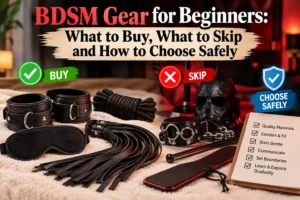
The right gear is part of safe practice. For beginners, leather restraints are one of the best starting points. Quality leather is firm, comfortable, and far safer than improvised rope or household materials for extended wear.
When buying your first BDSM gear, prioritize these five things:
Material quality: Genuine leather or high-quality padded materials prevent abrasion. Avoid cheap synthetics with rough or hard edges.
Adjustable fit: Restraints should be snug but never cut off circulation. Two fingers should fit comfortably under any cuff.
Quick-release mechanism: Every restraint must have a fast escape option. This is not optional. It is a basic safety requirement.
Reputable source: Buy from suppliers who specialize in BDSM gear. Generic costume shops do not meet proper safety standards.
Inspect before every use: Check for sharp edges, failing stitching, or weak buckles. Leather should be clean and conditioned.
At LeatherBond, every product is hand-inspected before shipping. Our best leather restraints for beginners are built with padded interiors, D-ring attachments, and secure quick-release buckles designed specifically for safe, comfortable exploration.
Research published in the Journal of Sexual Medicine found that BDSM practitioners showed no higher rates of psychological problems than the general population. Many actually report higher levels of communication skills and relationship satisfaction. The consistent factor in positive outcomes is that all activity is fully consensual and clearly negotiated.
In a power exchange dynamic, the dominant (Dom or Domme) takes the lead role directing the scene and holding responsibility for the submissive’s wellbeing. The submissive consensually yields control within agreed boundaries. It is worth noting that the submissive holds enormous real power: they set the limits, use the safeword, and can end any scene immediately.
Yes but take it slowly. Trust is foundational to safe BDSM, and trust takes time to build. Start with very low-risk activities, have thorough negotiation conversations, and grow your practice gradually. Never rush into advanced play with someone you don’t know well.
For absolute beginners, padded leather wrist cuffs are the best first purchase. They’re versatile, safe, easy to adjust, and comfortable for extended use. From there, a quality blindfold and a soft leather collar are natural next steps. Avoid complex restraint rigs or full-body bondage setups until you have solid experience and communication with your partner.
Leave the situation as soon as it is safe to do so. Ignoring a safeword is a serious consent violation not an accident, not a misunderstanding. The NCSF offers confidential support for people who have experienced violations within kink communities. Never stay in a dynamic where your safeword isn’t respected.
BDSM, when practiced with knowledge and genuine respect, can be a deeply rewarding part of your intimate life. The foundation never changes: consent, communication and care. Learn your safeword system. Negotiate before every scene. Make aftercare non-negotiable. Start slow and build experience before you explore further.
Good gear is part of that foundation. At LeatherBond, our handcrafted leather restraints, collars, and accessories are built to the same standard this guide was written with safety as the starting point and quality as the standard. Explore our beginner BDSM collection and take your first step with confidence.