You’ve prayed about it. You’ve talked to friends. You still can’t tell if this relationship is worth staying in.That gut-check feeling is common. Most Christians hit this exact wall at some point in dating.
The hard part isn’t knowing your values. It’s knowing which ones are truly non-negotiable.
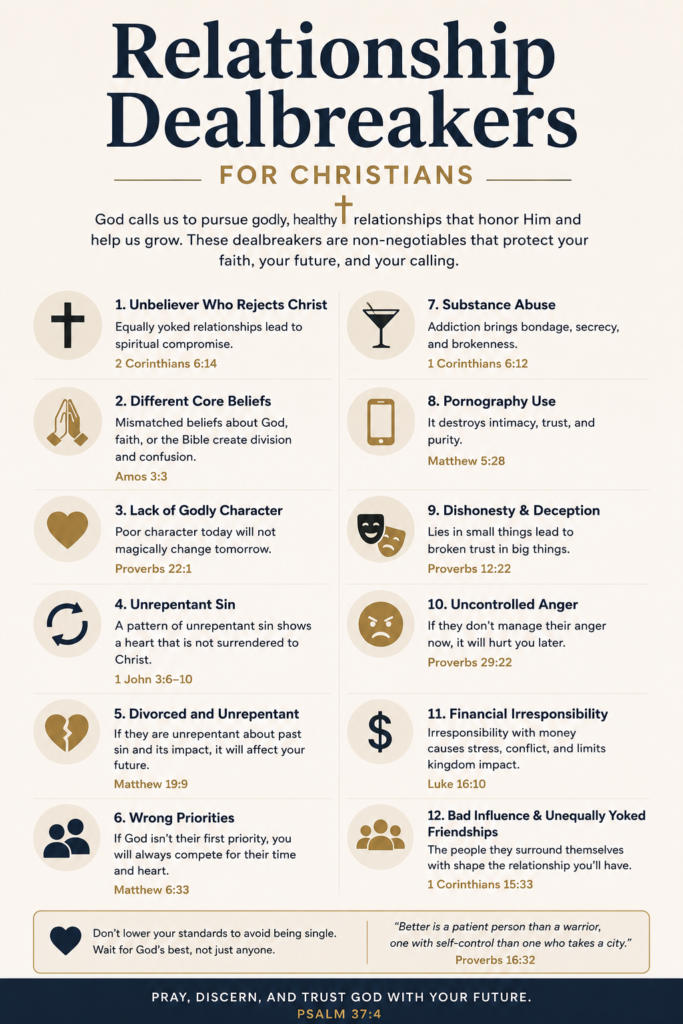
A relationship dealbreaker for Christians is a trait or belief gap serious enough to end the relationship, not just a minor annoyance. Common examples include mismatched faith commitment, different views on marriage roles, dishonesty, and unwillingness to grow spiritually. These issues tend to cause conflict that doesn’t resolve with time.
Let’s break down what actually counts, and what doesn’t.
A preference is something you’d like but can live without. A dealbreaker is something you can’t build a life around if it’s missing.
Liking the same music is a preference. Sharing the same core faith commitment is not.
Mixing these two up causes a lot of confusion in Christian dating. Get this distinction right, and everything else gets clearer.
Here’s a plain list, based on what shows up most often in Christian dating conversations.
Mismatched spiritual commitment. One person prioritizes faith daily. The other treats it as optional. This gap tends to widen over time, not shrink.
Different views on marriage roles. Some couples want a traditional structure. Others want something more equal. Neither is wrong, but mismatched expectations cause real friction.
Dishonesty. Trust is the base layer of any relationship. Once it’s broken repeatedly, it’s hard to rebuild.
Unwillingness to grow. Everyone has flaws. A dealbreaker shows up when someone refuses to work on theirs.
Financial irresponsibility. Chronic overspending or hiding debt creates stress that spills into every part of a relationship. Shared financial values matter more than people expect.
Different life goals. Wanting kids versus not wanting kids is a common example. This isn’t something that compromise usually fixes.
Conflict avoidance or explosive anger. Healthy conflict resolution keeps small issues small. Without it, small issues turn into big ones fast.
“Unequally yoked” refers to a relationship where one partner’s faith commitment doesn’t match the other’s, making shared spiritual direction difficult. The term comes from 2 Corinthians 6:14, where two oxen of different strength pulling one plow struggle to move forward together. Applied to dating, it means a serious mismatch in faith priorities.
This doesn’t mean both partners need identical beliefs on every detail. It means both need a shared commitment to growing in faith together.
Denomination differences can work if both people respect each other’s practice. A faith versus no-faith gap is a different story.
Bring it up early, not after months of avoiding it. Waiting only makes the conversation harder.
Use specific examples instead of vague statements. “I want us to pray together regularly” says more than “I want us to be spiritually connected.”
Listen as much as you talk. A real conversation goes both directions.
Not every difference needs to end things. Some gaps close with time, conversation, and shared growth.
A partner who’s newer in their faith journey isn’t automatically a mismatch. What matters is whether they’re moving in the same direction as you.
Ask yourself one question: is this a fixed trait, or a growth area? That answer usually tells you what you’re dealing with.
A red flag is a warning sign worth watching. A dealbreaker is a confirmed problem that won’t change.
Lying once might be a red flag. A pattern of lying is a dealbreaker.
Learning this difference stops you from either overreacting too soon or staying too long. Both mistakes are common.
Ignoring early warning signs. Most dealbreakers show themselves early, often within the first few months.
Assuming love will fix everything. Love doesn’t resolve a fundamental mismatch in values or faith direction.
Staying quiet to avoid conflict. Silence doesn’t make a dealbreaker disappear. It just delays the conversation.
Confusing compatibility with chemistry. Strong attraction can mask a values gap for a while. It won’t cover it forever.
What is considered a dealbreaker in a Christian relationship? Mismatched faith commitment, dishonesty and unwillingness to grow spiritually top the list. These issues tend to create ongoing conflict rather than fading with time.
Is denomination a dealbreaker for Christians dating? Not usually, as long as both partners respect each other’s practice and share core beliefs. A bigger concern is a mismatch in overall faith priority, not denomination alone.
What does “unequally yoked” mean in dating? It describes a relationship where one partner’s faith commitment doesn’t match the other’s. The term comes from 2 Corinthians 6:14 and points to a difficulty moving forward together spiritually.
How do you know when to walk away from a relationship as a Christian? Walk away when a pattern of dishonesty, disrespect, or spiritual disinterest doesn’t change despite honest conversation. A single mistake differs from a repeated pattern.
Can two people with different denominations make it work? Yes, if both partners respect each other’s practice and share the same core commitment to their faith. Problems usually come from a faith priority gap, not denomination alone.
Dealbreakers exist to protect your future, not to make dating harder. Get clear on yours early, and you’ll save yourself time and heartache.
Faith mismatch, dishonesty, and unwillingness to grow top the list for most Christians. Everything else usually falls into the “preference” category, not the “dealbreaker” one.
If you’re building a life that reflects your values in every part of your home, browse LeatherBond’s handmade leather collection for pieces built to last, just like the relationships worth keeping.