If you’ve ever searched “what is BDSM,” “what does BDSM stand for,” or “BDSM meaning” you’re far from alone. BDSM is one of the most searched sexual and lifestyle topics on the internet yet it remains widely misunderstood. Pop culture, movies and misinformation have painted an incomplete (and often inaccurate) picture of what BDSM actually is.
In this guide, we break it all down clearly, honestly, and without judgment. Whether you’re simply curious, exploring your sexuality or looking to understand a partner’s interests, you’ll find everything you need to know right here.
BDSM is an acronym that covers a wide spectrum of consensual adult practices. Here’s the full BDSM definition broken down letter by letter:
| Letter(s) | Stands For | What It Means |
|---|---|---|
| B | Bondage | Restraining a partner using ropes, cuffs, ties or other tools |
| D | Discipline | Agreed-upon rules and consequences within a relationship |
| D | Dominance | One partner taking a leading, controlling role |
| S | Submission | One partner willingly surrendering control |
| S | Sadism | Deriving pleasure from giving consensual pain or power |
| M | Masochism | Deriving pleasure from receiving consensual pain or power |
So when someone asks, “What is the full meaning of BDSM?” it’s Bondage, Discipline, Dominance, Submission, Sadism and Masochism. These six words represent a broad world of consensual adult interaction built on trust, communication, and mutual pleasure.
At its core, BDSM is a consensual exchange of power between adults who have openly agreed to explore specific roles, sensations, and dynamics together.
It is not abuse. It is not assault. And it is absolutely not something that happens without clear, enthusiastic consent.
Think of BDSM less like a single act and more like an umbrella underneath it sits dozens of different practices, from something as mild as light bondage during sex to deeply committed lifestyle relationships with defined dominant/submissive roles 24 hours a day.
When people ask about BDSM sex or “what does BDSM mean in sex,” they’re usually asking how BDSM works in a physical, intimate context.
BDSM in sex can include:
It’s worth noting that not all BDSM is sexual. For some people, the power exchange, trust, and emotional connection are the primary draw the physical intimacy is secondary.
The BDSM lifestyle (sometimes called “the lifestyle”) refers to people who integrate BDSM dynamics into their everyday lives not just in the bedroom.
This can look like:
People in the BDSM lifestyle are everyday professionals, parents, teachers and creatives. The lifestyle is about intentional relationship design not anything extreme or dangerous.
Understanding BDSM means understanding the roles people take within it:
The partner who takes control. They lead the dynamic, set the rules, and are responsible for their partner’s wellbeing during a scene or relationship.
The partner who willingly surrenders control. Submission is an active, powerful choice not weakness. A submissive holds enormous influence in any BDSM dynamic.
Someone who enjoys both dominant and submissive roles, shifting depending on the partner or mood.
“Top” refers to the person performing an act (e.g., giving sensation), while “Bottom” is the receiver. These terms don’t always align with Dom/sub someone can be a dominant bottom.
Every legitimate BDSM practitioner lives by one non-negotiable principle: consent.
The most widely used framework is SSC Safe, Sane, and Consensual:
Another popular framework is RACK Risk-Aware Consensual Kink which acknowledges that some BDSM activities carry inherent risks, but those risks are understood and accepted by both parties.
A safeword is a pre-agreed word or signal that immediately stops all activity. Common systems include the traffic light system: Green = continue, Yellow = slow down, Red = stop completely. Safewords are sacred in BDSM ignoring one is a serious violation.
One of the most important distinctions to make is between BDSM and abuse. They are not the same.
| BDSM | Abuse |
|---|---|
| Fully consensual | No consent |
| Both partners can stop at any time | Victim cannot freely leave or stop |
| Negotiated in advance | Unilateral decision by abuser |
| Rooted in mutual trust and respect | Rooted in control and harm |
| Aftercare and emotional check-ins are standard | No consideration for victim’s wellbeing |
If you are ever in a situation that feels unsafe or non-consensual, that is not BDSM that is abuse, and you deserve support.
A BDSM relationship is a relationship romantic, sexual or otherwise where BDSM dynamics are a core part of how two (or more) people connect.
These relationships can be:
Communication is the backbone of every healthy BDSM relationship. Partners negotiate boundaries, discuss desires openly and check in regularly before, during and after scenes.
Aftercare is one of the most important and least discussed parts of any BDSM session.
After an intense experience, both partners often experience a drop in adrenaline and endorphins. Aftercare is the process of coming back to earth together: cuddling, talking, eating, drinking water, wrapping up in a blanket or simply checking in on how each person feels.
It’s not optional. It’s essential. And it’s one of the things that separates healthy BDSM from harmful experiences.
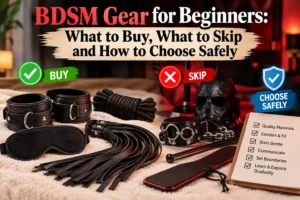
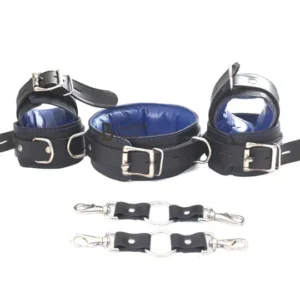
If you’re curious about the physical side of BDSM, here are some of the most common items people use:
Quality matters. Well-crafted leather BDSM gear from reputable brands is both safer and more comfortable than cheap alternatives.
More common than you might think. Studies suggest that anywhere from 5% to 25% of adults have engaged in some form of BDSM activity. Bondage, role-play and light power exchange regularly appear on lists of the most common sexual interests globally.
The BDSM community is large, diverse and welcoming. People of every gender, sexuality, background and age (18+) participate often finding that the honesty and communication BDSM requires actually makes their relationships stronger.
Q: What does BDSM stand for?
A: BDSM stands for Bondage, Discipline, Dominance, Submission, Sadism, and Masochism a broad term covering consensual adult power exchange and sensory practices.
Q: Is BDSM legal?
A: Yes. Consensual BDSM between adults is legal in most countries. The key word is consensual all activity must be freely agreed upon by all parties.
Q: Does BDSM always involve pain?
A: No. Many forms of BDSM involve no pain at all. Bondage, role-play, and power exchange can all be entirely sensation-free. Pain is one element not a requirement.
Q: Can anyone try BDSM?
A: Any consenting adult can explore BDSM. The most important starting points are open communication, education, and going at your own pace.
Q: What is a BDSM collar necklace?
A: In the BDSM lifestyle, a collar is a symbolic piece of jewelry often leather or metal that represents a committed Dom/sub relationship. It carries meaning similar to an engagement ring in traditional relationships.
Q: What is the BDSM lifestyle?
A: The BDSM lifestyle refers to integrating BDSM dynamics like Dom/sub roles or power exchange into everyday life, not just during intimate encounters.
Q: What’s the difference between a Dom and a Top?
A: A Dom leads the relationship dynamic. A Top performs actions during a scene. These often overlap but aren’t identical — someone can be a submissive Top, for example.
Q: What does “sub drop” mean?
A: Sub drop is the emotional or physical low a submissive may feel after an intense BDSM session, caused by a drop in endorphins. Aftercare helps manage sub drop.
It’s a broad, consensual and deeply personal world of human connection, trust, and exploration. Whether you’re drawn to bondage, fascinated by the psychological depth of Dom/sub dynamics or simply trying to understand what the acronym means, the most important thing to know is this: BDSM is built on consent, communication and care.
If you’re curious about exploring the BDSM lifestyle, start with research, talk openly with your partner and take your time. There’s no rush and no pressure to try anything before you’re ready.
Premium BDSM gear and bondage accessories for adults. Explore thoughtfully selected restraints, cuffs, collars and accessories with a focus on quality, privacy and discreet shopping.
If you have any questions or comment for us, fill out our Contact us form with all of your details or send us direct email.