A leather harness is a distinctive accessory that combines traditional leather craftsmanship with modern fashion and personal expression. Made from leather straps, buckles, rings and connecting hardware, it is designed to fit around different areas of the body, including the chest, shoulders, waist and torso.
Depending on its construction, a leather harness can serve as a decorative fashion accessory or a specialized piece of equipment. Over the years, leather harnesses have developed beyond their original associations with underground fetish and LGBTQ+ leather communities. Today, they are also recognized in alternative fashion, music festivals, high-fashion runways, clubwear and contemporary streetwear. Their structured appearance makes them a popular choice for people who want to create a bold outfit or express their individual style.
There are several types of leather harnesses available, including chest harnesses, body harnesses, shoulder harnesses, and bondage harnesses. Men’s and women’s designs also offer different strap arrangements, coverage levels, and styling possibilities.
However, choosing the right leather harness involves more than selecting an attractive design. Material quality, strap adjustment, hardware, stitching, sizing and intended purpose all influence the overall experience.
This guide explores everything you need to understand about leather harnesses, from their history and different styles to choosing the right fit, creating outfits, understanding harness leather and maintaining your accessory.
A leather harness is a wearable accessory constructed from leather straps connected through buckles, rings, and other hardware. It is generally designed to fit around the chest, shoulders, back, waist, or other areas of the torso.Unlike traditional clothing, a leather harness does not necessarily cover the entire body. Instead, its strap-based construction creates a structured design that follows the body’s shape.Leather harnesses are available in different styles, from simple chest accessories to more elaborate body designs.
They generally serve two main purposes.
A fashion leather harness is primarily worn as a statement accessory. It can be layered over a shirt, T-shirt, dress, or tank top, or worn directly against the skin.
Its straps create visual structure and add contrast to an outfit. Depending on the design, it can complement alternative fashion, clubwear, festival clothing, and other distinctive styles.
Some leather harnesses are designed for specialized applications, including BDSM-related activities, bondage, and strap-on use.
These products may feature different strap arrangements and hardware depending on their intended purpose.
It is important to understand that a decorative leather fashion harness is not automatically suitable for functional restraint applications. Always consider the product’s intended use and construction.
Leather has a long history as a material associated with strength, durability, protection, and personal expression. Its ability to maintain structure while adapting to different applications has made it useful for both practical equipment and decorative clothing.
The modern leather harness, however, has a more specific cultural background.
During the 20th century, leather became increasingly associated with alternative fashion and fetish communities, particularly BDSM culture.
Leather garments, including harnesses, corsets, and restraints, developed symbolic associations with power, control, submission, sensuality, and empowerment.
Within LGBTQ+ leather communities, harnesses also became recognizable expressions of identity, pride, strength, and community.
During the 1960s and 1970s, sexual liberation movements helped increase the visibility of BDSM-related fashion and leather communities. Harnesses became associated with personal freedom and expressions that challenged traditional social expectations.
For many people, wearing a leather harness became about more than appearance. It could also communicate identity, belonging, and confidence.
Fashion designers eventually began incorporating elements of alternative and fetish-inspired clothing into mainstream collections.During the late 20th century, designers such as Vivienne Westwood and Jean-Paul Gaultier used leather and fetish-inspired details to challenge conventional fashion designs.
One recognizable example was Jean-Paul Gaultier’s corset worn by Madonna during her 1990 Blonde Ambition Tour. The outfit demonstrated how elements inspired by alternative fashion could become influential in mainstream entertainment and clothing.During the 2010s, celebrities and influencers further increased the visibility of harness-style accessories.
Leather harnesses appeared in fashion shows, editorial photography, red-carpet appearances, and music festivals. They increasingly became recognized as statement accessories connected to individuality and self-expression.
Today, leather harnesses can be worn over dresses, shirts, tank tops, or directly against the skin.
Their appeal is connected to several fashion trends:
Although their original cultural associations remain important, leather harnesses now appear in a wider range of fashion environments.
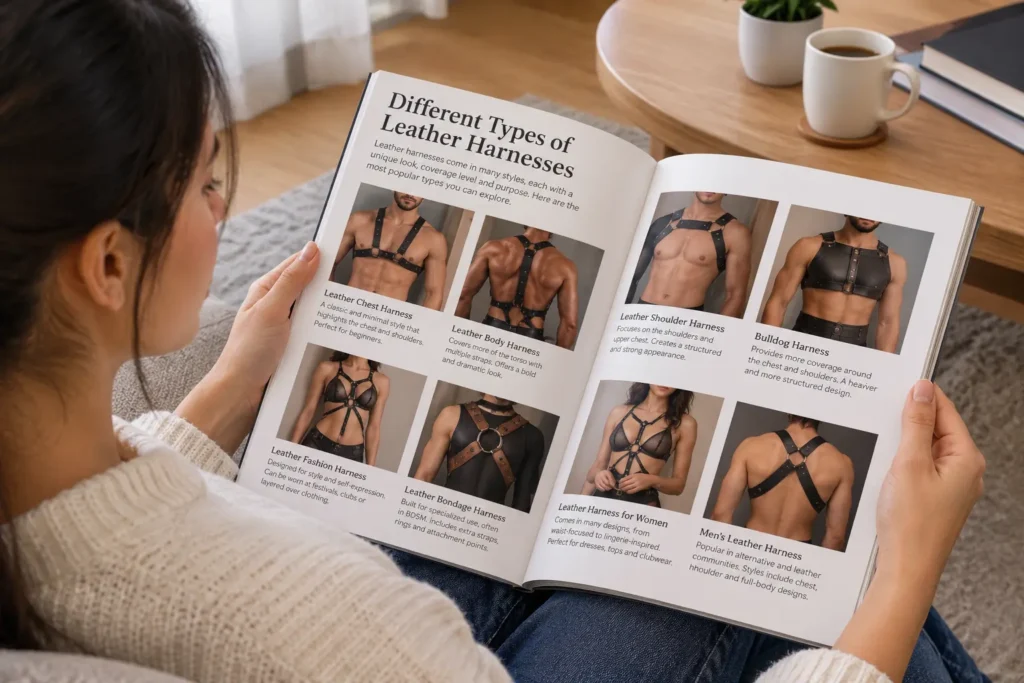
Understanding the available styles is an important part of choosing a leather harness.Different designs offer different levels of coverage, strap arrangements, and visual appearances. Some are minimal and straightforward, while others cover a larger portion of the torso.
A leather chest harness is one of the most recognizable styles. It generally features straps that extend around the chest and shoulders, creating a structured appearance. One popular variation is the X-harness, where two straps cross over the chest to form an X shape. Some designs also include a connecting ring positioned around the center of the chest.
Main characteristics:
A leather chest harness is a popular starting point for people exploring harness fashion because its design is relatively simple compared with more elaborate body styles.
A leather body harness covers more of the torso than a traditional chest harness.Depending on the construction, it may include shoulder straps, chest straps, waist connections, and additional sections around the back.
The additional straps create a more dramatic appearance and offer different styling possibilities. Leather body harnesses are available for men and women, with designs ranging from minimal fashion accessories to more elaborate BDSM-inspired pieces.
A leather shoulder harness focuses on the shoulder and upper chest area.
Its straps generally extend over the shoulders and connect around the chest or back. Some designs include additional rings, buckles, or connecting straps.
This style creates a structured upper-body appearance while emphasizing the shoulder line. It can be worn over a fitted shirt, tank top, or directly against the skin, depending on its design.
A bulldog harness generally provides more coverage around the upper chest and shoulders than a traditional X-harness.Its construction creates a vest-like silhouette, resulting in a heavier and more structured appearance.This design is associated with leather events and fetish nights, particularly among people who prefer a more substantial accessory. Compared with a minimal chest harness, a bulldog harness can create a stronger visual statement.
A leather fashion harness is primarily designed for appearance and personal styling.It may feature different strap arrangements, decorative rings, contrasting materials, and distinctive hardware.Fashion harnesses can be worn at music festivals, clubs, fashion events, photo shoots, and alternative fashion gatherings.They can also be layered over ordinary clothing to create a more distinctive outfit.
A leather bondage harness is designed for specialized BDSM-related use.
Depending on its intended application, it may feature additional straps, rings, attachment points, and connecting hardware.Unlike a decorative fashion harness, a bondage harness is selected according to its intended function as well as its appearance.Always check the product description and construction details before choosing one for specialized use.
Women’s leather harnesses are available in different designs, from minimal fashion accessories to more elaborate body styles.
Popular arrangements include:
They can be paired with dresses, tops, leather pants, clubwear, and festival outfits.A women’s leather body harness can add structure to an outfit while creating contrast between leather straps and other clothing materials.
Men’s leather harnesses are recognizable accessories in alternative fashion and leather communities.
A men’s leather chest harness generally provides a minimal appearance, while a man’s leather body harness covers more of the torso.Popular styles include X-harnesses, bulldog harnesses, shoulder harnesses, and full-body designs.These accessories can be worn directly against the skin or layered over tank tops, T-shirts, and other clothing.The best design depends on personal preferences, comfort, coverage, and the intended occasion.
Material selection is another important consideration when buying a harness. Leather and neoprene offer different appearances, maintenance requirements, and wearing experiences.
| Feature | Leather | Neoprene |
|---|---|---|
| Appearance | Traditional leather texture | Modern, sporty appearance |
| Weight | Generally heavier | Lightweight |
| Comfort | Can feel warm | Suitable for comfortable extended wear |
| Maintenance | Requires conditioning | Easy to rinse and air dry |
| Water exposure | Requires careful handling | More water-friendly |
| Price | Generally more expensive | Generally more affordable |
| Aging | Can develop a patina | Does not develop leather patina |
| Best suited for | Leather events and traditional styling | Casual wear, clubs, and pool-related occasions |
Leather has a distinctive appearance and texture that makes it appealing to people who appreciate traditional leather accessories.
Its main advantages include:
However, leather can be heavier and warmer than neoprene. It also requires cleaning and occasional conditioning.
Neoprene offers a different experience.
It is lightweight, relatively easy to clean, and more suitable for situations where water exposure is a consideration.
Its advantages include:
Its main disadvantage is that it does not provide the same traditional appearance and cultural presence associated with leather.
The right material depends on your preferences and intended use.Choose leather if you appreciate its traditional appearance, structured straps, and distinctive aging characteristics.Consider neoprene if lightweight construction, easier cleaning, and water-friendly properties are more important.Neither material is automatically the best choice for everyone.
The term harness leather is sometimes confused with a wearable leather body harness. However, these terms describe two different things.
A leather body harness is a wearable accessory made from leather straps arranged around the body.
Harness leather refers to a type of firm, heavy leather traditionally used for horse harnesses and other equipment designed to withstand physical stress.Understanding this distinction is useful when researching leather products or comparing material descriptions.
Traditional harness leather is generally associated with vegetable tanning, a process that uses tannins derived from tree bark and other plant materials.
This process produces a firm and dense leather material.
Some important characteristics include:
Firm construction: Harness leather is generally heavier and firmer than many softer fashion leathers.
Dense grain: Its tight grain structure contributes to its distinctive appearance and feel.
Thickness: Traditional harness leather is commonly described as approximately 3–5 mm thick, depending on the application.
Resistance to stretching: It has historically been used in applications where resistance to stretching and physical stress is important.
Patina development: With use and appropriate conditioning, harness leather can develop a deeper and more distinctive surface appearance.
Traditional harness leather has been used in several applications, including:
Its traditional applications demonstrate why the material is associated with durability and structure.
Not every fashion leather accessory uses traditional harness leather.
Fashion products may use different leather types depending on the intended design, appearance, flexibility, and construction.
When purchasing a leather body harness, examine the actual material description rather than assuming that every product marketed as a leather harness is made from traditional harness-grade leather.
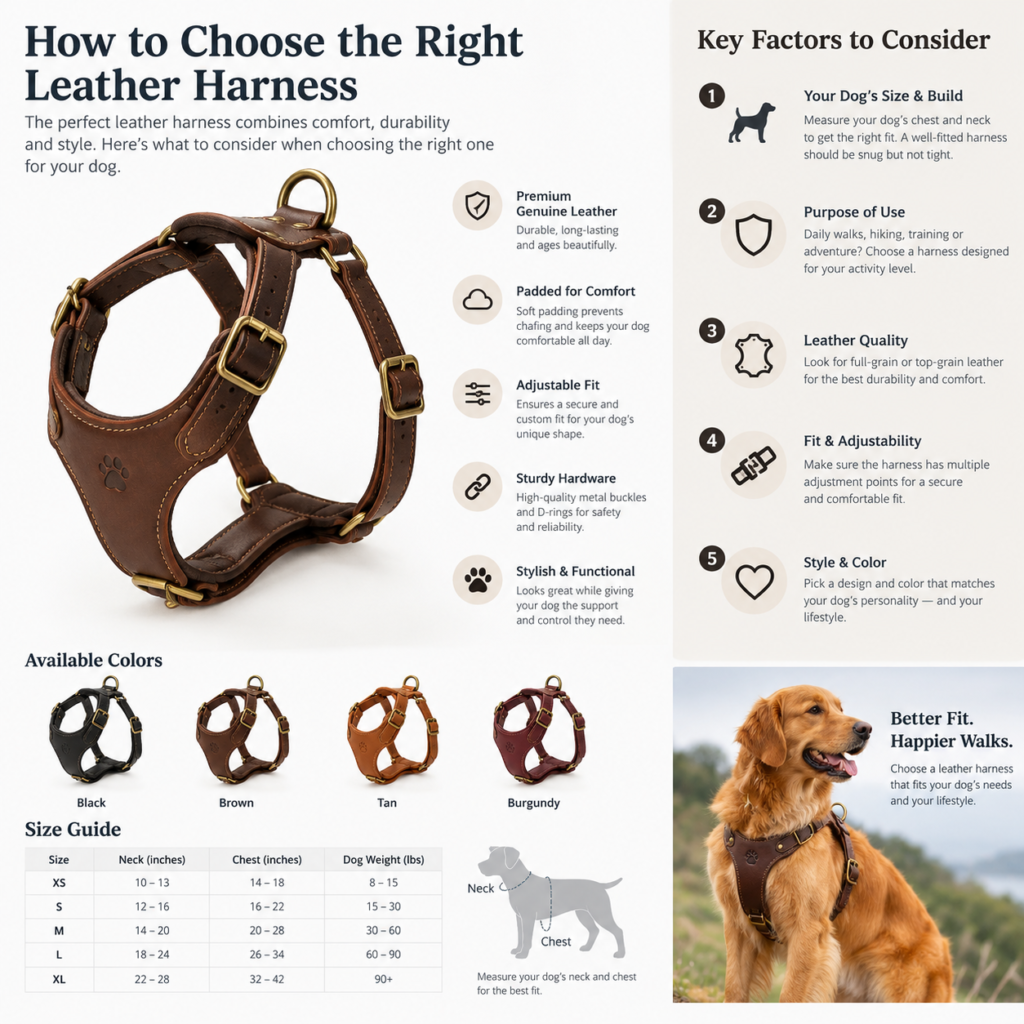
Selecting the right leather harness involves considering more than its appearance.The material, size, strap design, hardware, and intended purpose all influence the final choice.
Here are the most important factors to evaluate.
For chest harnesses, the chest measurement is generally the most important sizing reference.Measure around the fullest part of your chest, slightly below the armpits.Keep the measuring tape snug but not excessively tight.Compare your measurement with the manufacturer’s sizing information before selecting a size.
Adjustability is an important feature when purchasing a leather harness.Many designs include multiple buckle holes or sliding adjusters that allow the wearer to change the strap length.Some designs provide an adjustment range of approximately 3–4 inches, although this varies by product.Adjustable straps make it easier to achieve a comfortable fit.
Consider the appearance and coverage you prefer.
A chest harness is suitable for a relatively minimal look.A body harness provides more coverage and a more dramatic appearance.A shoulder harness emphasizes the upper body, while a bulldog harness offers a wider, vest-like silhouette.Your preferred style should match the clothing and occasions for which you intend to wear it.
Strap width affects the overall appearance and wearing experience.
Narrow straps create a more minimal design, while wider straps provide a heavier and more structured appearance.People with broader builds may prefer X-harness designs, while bulldog harnesses can create additional visual width for slimmer builds.Wider straps may also help distribute pressure across a larger area, depending on the construction.
Hardware plays an important role in the construction and appearance of a leather harness.
Look at the buckles, rings, connecting points, and other metal components. Solid brass and stainless steel are materials worth considering when comparing hardware quality.Check that the buckles operate properly and that connecting components are securely attached.
Stitching is another important detail to examine.
Look for tight, even, and consistent stitching along the straps and around connecting points.
Loose threads, uneven seams, and poorly finished connections may indicate lower-quality construction.
When comparing leather harnesses, look for clear information about the material.
Full-grain leather and vegetable-tanned leather are useful terms to understand when researching traditional leather products.Avoid relying only on general descriptions without checking the actual material specifications.
A leather harness should fit comfortably and allow normal movement.
Check the strap positioning, adjustment range, and areas where leather contacts the body.If the design feels uncomfortable or restricts movement, it may not be the right size or style.
A properly fitted leather harness should feel secure without creating unnecessary pressure.
If it is too tight, the straps may cause discomfort. If it is too loose, the harness may move around and lose its intended position.
Use the following guidelines when checking the fit.
Two-finger guideline: You should generally be able to slide approximately two fingers underneath each strap.
Flat strap positioning: Straps should lie flat rather than twisting or bunching.
Comfortable movement: Raise your arms, twist your torso, and reach overhead to check the range of motion.
Center ring positioning: If the design includes a central chest ring, it should generally sit around the middle of the chest, between the pectoral muscles.
Different harness styles can create different visual effects.
These are general styling considerations, not strict rules. Comfort and personal preference should remain the most important factors.
The process of wearing a leather harness depends on its design.
Most fashion and body harnesses include some combination of shoulder straps, chest straps, back connections, and adjustable buckles.
Follow these general steps.
Before putting on the harness, loosen the adjustable straps.
This makes it easier to position the accessory without pulling or twisting the leather.
Bring the shoulder straps over the appropriate shoulders.
Make sure each strap sits flat and is not twisted.
If the harness includes leg loops, step into them according to the product’s design.
Secure the front or back closure, depending on the construction.
Check that each buckle is properly fastened.
Adjust the straps separately until the harness sits comfortably.
Avoid excessive tightening or creating pressure around the body.
Move your arms, twist your torso, and check that the straps remain comfortably positioned.
There should be no pinching or unnecessary restriction.
For specialized functional harnesses, follow the manufacturer’s specific instructions.
A leather harness can be styled in several ways depending on the design and the occasion.
Its strap-based construction makes it suitable for layering over different clothing materials or wearing directly against the skin.
One recognizable combination is a leather harness worn directly against the skin with jeans and boots.
This creates a classic leather-inspired appearance and allows the harness to become the main accessory.
A leather harness can also be worn over a simple T-shirt or tank top.
For example, a black T-shirt with a black leather harness creates a coordinated appearance.
This approach allows people to experiment with harness fashion without making the entire outfit overly elaborate.
Music festivals provide opportunities to experiment with distinctive accessories and alternative fashion.
A leather harness can be paired with:
The goal is to create a balanced outfit where the harness complements the other pieces.
For clubwear, a chest harness can be paired with fitted clothing or other statement accessories.
A simple shirt and leather harness can create a layered appearance, while a more elaborate harness can become the main feature of the outfit.
Women’s leather harnesses can be layered over dresses, tops, and lingerie-inspired outfits.
Waist-focused designs create structure around the waist, while chest-framing harnesses emphasize the upper body.
The best combination depends on the harness design and the desired appearance.
A black T-shirt, black leather harness, and dark trousers create a simple and coordinated look.
The matching colors allow the harness to add structure without introducing too many contrasting elements.
For pool parties and occasions involving water, neoprene harnesses may be a more practical option because they are more water-friendly.
They can be combined with suitable shorts, swimwear, and casual footwear.
Leather requires more careful handling around water and should not automatically be considered suitable for wet environments.
Leather harnesses are associated with several fashion environments and social occasions.
Common settings include:
A leather harness can also be worn over a T-shirt or tank top for a more casual layered appearance.
However, the suitability of an outfit depends on the environment.
A bold leather harness may be appropriate for a fashion event or festival but less suitable for a formal workplace or family dinner.
Consider the dress expectations of the occasion before choosing your outfit.
Proper maintenance helps preserve the appearance and condition of leather.
Unlike neoprene, leather requires occasional conditioning and careful storage.
Use a clean, slightly damp cloth to gently wipe the surface after wearing the harness.
This helps remove surface dirt and residue.
Avoid soaking leather or exposing it to unnecessary moisture.
Leather can benefit from occasional conditioning.
Use an appropriate leather conditioner according to its instructions.
Conditioning helps maintain the leather’s appearance and prevents excessive dryness.
Choose a cool and dry storage location.
Avoid direct sunlight, excessive humidity, and strong heat sources.
Whenever possible, store the harness flat or hang it carefully.
Avoid repeatedly folding the straps because this can create unwanted creases.
Occasionally check buckles, rings, and connecting points.
Look for loose components, visible damage, and signs of wear.
Sweat can negatively affect leather over time.
Wiping the harness after wearing it is a simple habit that can help maintain its condition.
Neoprene requires a different cleaning routine.
Rinse it with fresh water after wearing, particularly if it has been exposed to sweat.
Allow it to air dry before storing.
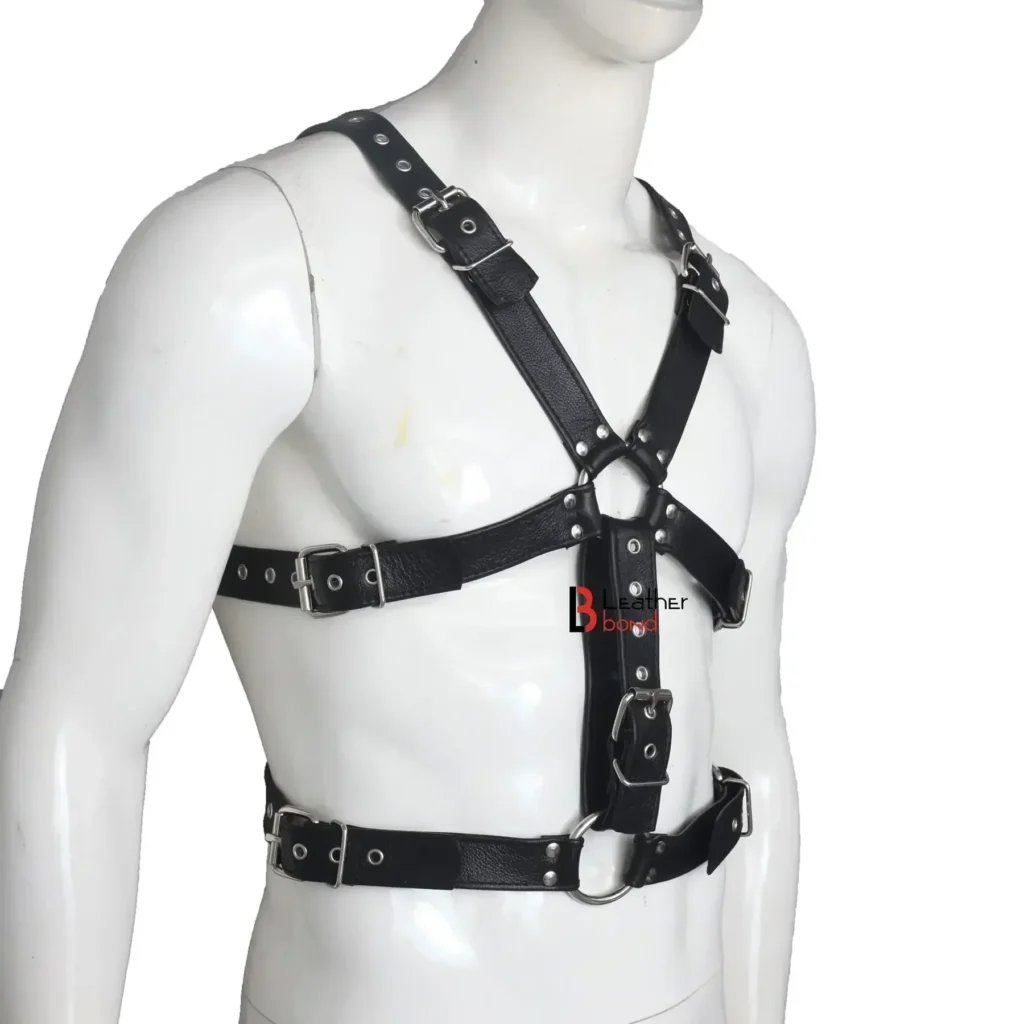
Before purchasing a leather body harness, examine its material, construction, hardware, and sizing information.A good-looking design is only one part of the decision.
Look for clear information about the leather used in the product.
Full-grain and vegetable-tanned leather are relevant material descriptions when comparing traditional leather products.
Do not assume that every product described as genuine leather has the same quality or characteristics.
Examine the stitching along the straps and around connecting points.
Consistent stitching is an important construction detail.
Check the material and finish of the buckles, rings, and other hardware.
Solid brass and stainless steel are options worth considering when comparing products.
Adjustability can make a harness easier to fit.
Check the available adjustment range and compare it with your measurements.
Choose a design that matches your intended purpose.
Fashion harnesses and specialized functional harnesses should not be treated as interchangeable.
Before purchasing, review the product description carefully.Look for details about leather type, strap construction, hardware, size, adjustment options, and care instructions.These details make it easier to compare products and understand what you are buying.
Use this checklist before selecting a leather harness:
Taking time to evaluate these factors can help you make a more informed purchase.
A leather harness is a wearable accessory made from leather straps connected through buckles, rings, and other hardware. It is worn around areas such as the chest, shoulders, waist, or torso and can be used for fashion or specialized applications.
A leather harness can be used as a fashion statement, an accessory for alternative clothing, or specialized BDSM-related equipment. Its intended purpose depends on the design and construction.
A chest harness generally focuses on the chest and shoulder area. A body harness covers more of the torso and may include additional waist, back, and shoulder straps.
Yes. Men’s leather harnesses commonly include chest, shoulder, and body designs. Women’s leather harnesses include waist-focused, chest-framing, lingerie-inspired, and full-body styles.
A simple adjustable chest harness is a practical starting point for people exploring harness fashion. Its relatively minimal design can be easier to style than more elaborate body harnesses.
A leather harness should fit snugly without creating excessive pressure. As a general guideline, approximately two fingers should fit underneath the straps. You should also be able to move comfortably.
Measure around the fullest part of your chest, slightly below the armpits. Keep the measuring tape snug but not tight, then compare your measurement with the manufacturer’s sizing chart.
Leather offers a traditional appearance, structure, and the ability to develop a patina. Neoprene is lighter, easier to clean, and more water-friendly. The better option depends on your preferences and intended use.
Yes. Fashion leather harnesses can be layered over T-shirts, tank tops, and other clothing. A black harness over a black shirt creates a coordinated layered look.
Gently wipe the surface with a slightly damp cloth. Allow it to dry naturally and use an appropriate leather conditioner occasionally. Store it in a cool, dry place.
Harness leather is a firm, heavy leather traditionally used for horse harnesses, belts, bridles, and saddlery. It is generally associated with vegetable tanning and a dense, structured construction.
No. Harness leather refers to a type of leather material, while a leather body harness is a wearable accessory made from leather straps. They describe different products and concepts.
Yes. Leather harnesses are commonly associated with music festivals and alternative fashion gatherings. They can be paired with boots, leather pants, chokers, and other accessories.
An X-harness generally uses crossing chest straps that create an X-shaped appearance. A bulldog harness offers broader upper-chest and shoulder coverage with a more vest-like silhouette.
Many leather harnesses feature multiple buckle holes or sliding adjusters. However, the adjustment range varies by design, so check the product specifications before purchasing.
Its lifespan depends on the leather quality, construction, frequency of use, and maintenance. Proper cleaning, occasional conditioning, and suitable storage can help preserve its condition.
Harness fashion is not limited to one gender. The important considerations are the measurements, strap arrangement, adjustment range, and overall fit.
Review the leather material, stitching, hardware, strap width, adjustability, sizing, and intended purpose. These factors help you evaluate whether a product matches your requirements.
A leather harness combines traditional leather styling with contemporary fashion and personal expression.From minimal chest harnesses to elaborate body designs, different styles offer different appearances, coverage levels, and wearing experiences.Understanding the differences between men’s and women’s leather harnesses, chest and body designs, and leather and neoprene materials can make the buying process easier.Pay particular attention to accurate measurements, adjustable straps, leather quality, stitching, and hardware. These details are important when comparing products and selecting an accessory that suits your preferences.It is also worth understanding the difference between a wearable leather body harness and traditional harness leather, as the two terms refer to different things.
Whether you prefer a classic leather chest harness, a structured body harness, or a fashion-focused design, choose an option that matches your style, fits comfortably, and serves its intended purpose.